Blog
Walking at the border where the grass is truly green
In the following blog, Dr Krešimir Žažar visits Ireland and takes a trip to the Republic of Ireland and Northern Ireland border where Professor Maggie O'Neill and Dr Michael McLoughlin are working.
A blog by Dr Krešimir Žažar
Day 1 – Wednesday September 23, 2026
The trip from South-Eastern edge of European Union toward its North-Western edge means a 3-hour flight which in both directions does not count as such because of the time zone switch. On arrival into Ireland, I became slightly younger as the clock turned one hour back. After that temporal ‘anomaly’, I experienced a certain ‘cultural anomaly’. Namely, the flight from Croatia landed ahead of the planned time, while the bus in Ireland was considerably late. The sociocultural geography of Europe should probably be reconsidered. Anyhow, the road trip to Clones, my home for the upcoming days, was comfortable and pleasant with occasional fear that we are driving on the ‘wrong side of the road’. The regulation of traffic – using the left side of the road - unlike the right-hand side traffic usage in most of Europe, is something that confused me all the time I was in Ireland. That is also the reason for a slight disorientation when crossing the street – never 100% sure which side of the road should be checked first, what also forced me to strictly obey the traffic rules, as feeling unsafe otherwise. Experience of taking part in traffic system operating in the ‘mirroring symmetry’ comparing to the system I used to participate, evoked Giddens’ concept of ‘practical consciousness’ as a great deal of social practices function as routinized performances. To conclude the first day on a more relaxed note, the evening ended with a glass of Guinness, embracing one of Ireland’s well-known traditions.
Day 2 – Thursday September 24, 2026
A mostly cloudy Thursday brought a quite extensive, 4-hour ethnographic walk through Clones. Later, I learned that the root of the word comes from Celtic language and means a meadow – a properly chosen toponym. Clones is a lovely town near the Irish/UK border, located on its Irish side. From the first glimpse, it can easily be concluded that the town has a rich history, going back thousands of years, and the geographical position, natural environment, and possibilities to cultivate the land are extraordinary. The layers of history are observable in the structure of the town, with diverse elements with different time stamps placed side by side in space. This spans from the neolithic period, through the Middle Ages, to the modern (and postmodern) times.
Cemeteries are important places for understanding history – I visited 4 of them – with the Famine Cemetery being the most impressive in terms of the compassionate emotional experience. Famine cemeteries are monuments to those who died during the Great Famine in 19th-century Ireland, when around one million people lost their lives. The famine also led to mass emigration, with approximately two million Irish people leaving the country, many to escape hunger and poverty. Some did not survive the difficult journey overseas.
The Great Famine (or Hunger) is deep scar in the collective memory of Irish people. Regarding the Famine Cemetery, it is interesting that it is placed at the outskirts of the town and it is not easy to find it. Paradoxically only a couple of hundred meters away is a huge meat factory, the most vibrant economic entity in the town. The contrast of so many dying from the hunger in the past and the abundance of the food in the same geographic space in the present, is sobering and led to analysis, within the context of the global framework, of the deep structural inequalities that persist. Many people in the Western world suffer from obesity while in the other parts of the world they are dying from hunger. It seems that mankind just does not learn important lessons from the past. Hopefully, the things will change in a more utopian-like future.
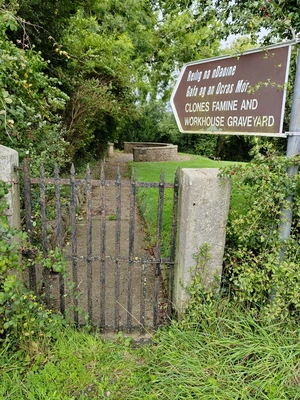
Famine Cemetery
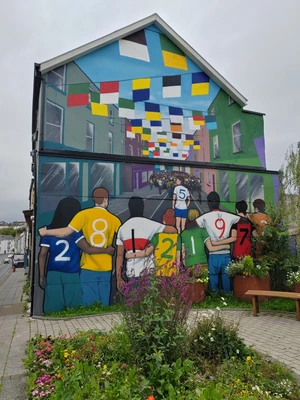
Mural in Clones
The traumatic stories from the past are also present from Irish/British, Catholic/Protestant conflict from the second half of the 20th century. Especially impressive is mural dedicated to the scene of a bomb attack in the early 1970s, portraying the tragedy of the event, but somehow also raises the hope for a more cohesive future. The meaning of the mural is most easily comprehendible if referring to the words of a participant in the research, so here is the quotation from an interview conducted by Maggie:
‘Well basically the story behind it is we were looking to brighten up the place, and we got money to do a mural and I felt it was important.. .there was a bombing one night and the next day Paddy McCabe was on the roof, you know, tidying up, cleaning up... There was nobody killed in the bomb, there was nobody actually injured in the bomb, but he fell off the roof and was killed, died on the street… we wanted to acknowledge Paddy McCabe. I thought it will be important to have the GAA connection, that Clones is a GAA town. The Ulster Cup final has been held here nearly every year since nineteen forty seven.. eighty odd years. I said let's depict Fermanagh Street on an Ulster final day with the crowds, the colour, the buzz... let's put Carl O'Connell in it.
'Carl O'Connell played wing half back for Monaghan. He was in number five and number seven. We went for number five and he's wearing the Monahan jersey. And then we put supporters from the other eight counties with their arms around each other facing him. Carl’s grandfather died on that spot and the other eight counties with their various county jerseys with their arms around each other in solidarity on Ulster final day with him at the centre of it. And the numbers that are on the jerseys. There are eight jerseys. There are nine counties in Ulster. Monaghan is the centrepiece in it, Carl O'Connell. And the other eight have numbers on the back of them and the numbers are the date that the bomb went off. 28, 12, 1972.’
Coming back to the present, I was surprised to observe abandoned buildings in the town centre, some of them being derelict. It indicates to me a fierce depopulation process of younger people emigrating out from the town. On the other hand, there is immigration ongoing as people from Africa, Asia and South America come to live and work in Clones. This international flavour is also there and brings a hope for a more harmonic, inclusive future.
The surrounding nature is beautiful, in terms of landscape, plants, (unusual from my perspective) flowers, animals – mostly cows, but also one lonely horse walking across the hill near the canal enjoying synchronicity with nature.
This ethnographic immersion was a fully enriching experience enabling deeper understanding of the field in all its dimensions: natural, social, cultural, economic, etc.
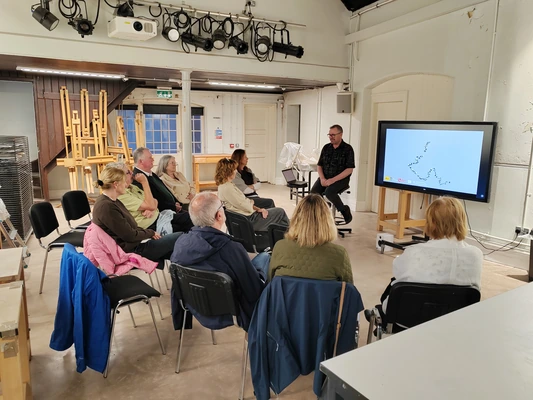
Artist Talk
However, this was not end of that super interesting Thursday, as later in the evening there was ‘Artist Talk’ event in the Old Post Office in Clones, run by ‘Monaghan Arist Collective’ and hosted by very kind Eileen and Joanne, who provided remarkable hospitality for EUROBORDERWALKS team members for this particular event, but also for workshop in the following two days. The Artist who talked was Michael Mcloughlin and he presented a brief history of his artistic projects, including his role in EUROBORDERWALKS. He focused upon sound recordings and the possibilities to express the experiences of communities through that medium. The questions from the audience were intriguing and triggered an interesting debate of the possibility of reaching mutual understanding through art and the ultimate purpose of art. Such philosophical questions marked the end of the highly inspiring day and occasionally reappeared in the informal discussions in the following days.
Day 3 – Friday September 25, 2026
The beautiful premises of Old Post Office were the venue of the Artist Workshops scheduled for the next two days. The first day gathered almost 20 participants including EUROBORDERWALKS team members, while majority of participants were inhabitants of Clones and Monaghan County with whom Maggie previously conducted walking interviews. It was Maggie as PI of the project who did a very nice introduction, providing the overall context and explaining the main goals of our project with my humble self being invited to add a few notes about specificities of the Croatian/Bosnian Herzegovinian border.
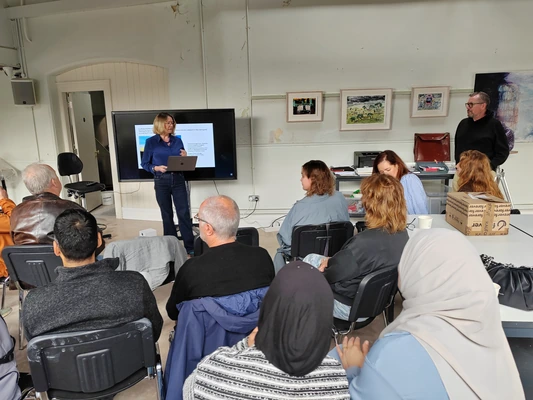
Opening of the Workshop
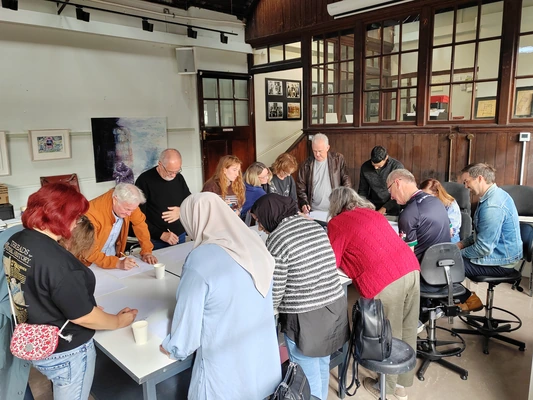
At the Workshop
The workshops were led by Michael who firstly gave us all the task of drawing a map of our route to the workshop and we took it in turns to share our drawings and routes. This was followed by a shared mapping of Clones, underlining important landmarks and places which have a special meaning to the workshop’s participants. This was done through joint discussion, and its observable outcome was a nicely produced huge map with important spots and objects pinned on it. The most interesting part of Friday’s workshop was a discussion within which every participant (in a circular order) shared their lived experience in the bordering town of Clones witnessing difficult recent history, but sometimes also anecdotal stories of crossing border checks in the past. Through individual stories motives of infrastructural deficits, challenges of a daily life in Clones, but also attachment to the lovely town (sometimes also referred to as ‘centre of the world’) emerged. In wrapping up the main points, I drew even further striking resemblances with the Croatian/Bosnian Herzegovinian context and pointed out many similarities with Clones – as being peripheral, remote, and the border areas in the Croatian context. One of the surprising features which did not emerge in the discussion, and I underlined this in my summary, was a lack of references to local politicians, which in a Croatian context is barely imaginable.
Day 4 – Saturday September 26, 2026
The second half-time of the workshop commenced with a Dadaistic approach in striving to achieve meaning of ‘a border’ that the notion entails for each of us, while 5 individual associations connected with that particular term were later reassembled in a huge joint collage. In the next step, using the map we produced yesterday, participants were asked to reflect on the most important places to them in Clones. Once this task was accomplished, we did a joint group walk and visited the selected places, creating a EuroBorderWalks Clones walking tour. At every spot, a shorter talk of local resident(s) about the places was shared and we did a one minute of audio recording in silence at each spot, to record the sounds of the place itself. Still, I am very curious about the outcome of recordings, which will be (as well as to other output materials) shared to the participants of workshop, our co-partners in the project of collective co-creation of knowledge about borders. Despite lovely weather to date on my trip, a rain followed us along the way making the general atmosphere ‘typically’ Irish. Upon arrival to the Old Post Office, a short summary discussion occurred and marked the end of an amazing series of workshop(s). I must stress that I felt very pleasant as participants were very open and totally embracing towards me, so I had a being at home feeling though I for moments struggled with an Irish accent.
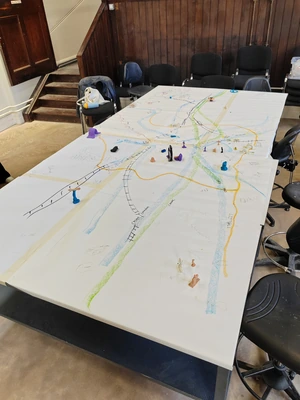
Map of Clones
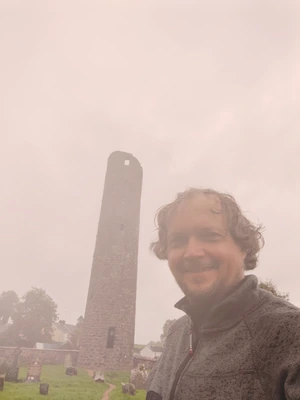
During the Walk through Clones
Immediately after the workshop, I joined Maggie for two highly interesting walking interviews with two women, one from outside of Clones whose family home was very close to the border and a local artist who had lived in Clones for many years – during her walk we walked to the border and looked over at where her field and house were situated. It was vastly enriching experience listening to their life narratives, which added further precious puzzles in the challenging task of full comprehension of the field.
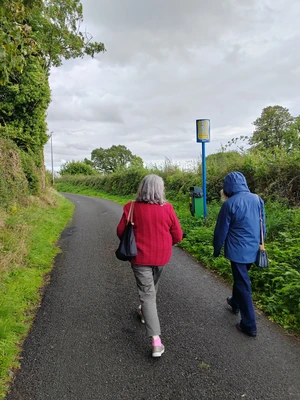
The Walking Interview
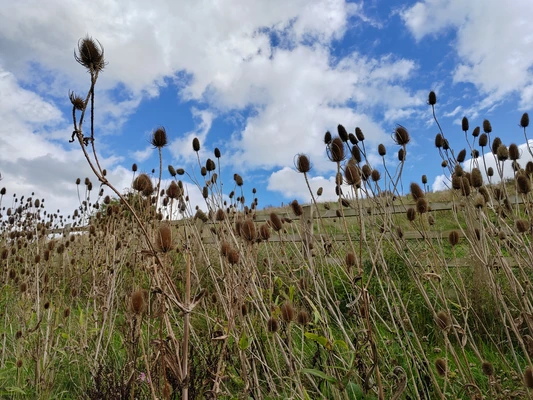
The Nature in Clones
Day 5 – Sunday September 27, 2026
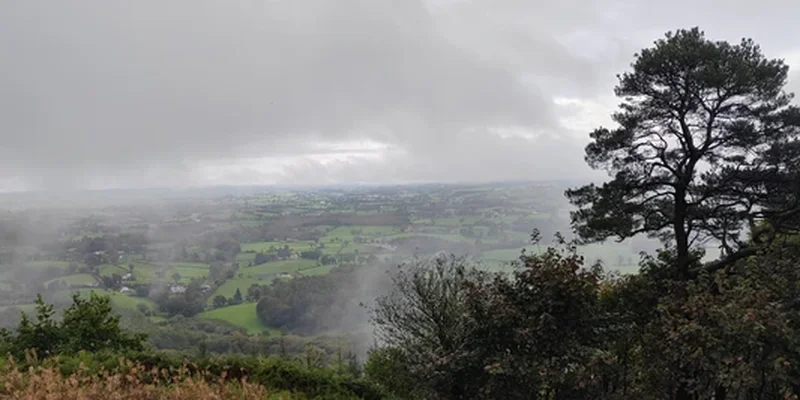
A rainy Sunday morning marked the time for leaving Clones and heading towards the UK side of the border as we had a walking interview appointed there. In particular, the destination we reached for the walk is Knockmany Forest where we were accompanied by two friends – one who lived in Northern Ireland and one in the Republic of Ireland – doing their usual Sunday morning walk every week. We very much appreciated their giving the time and inviting us to join them along their weekly walk. The forest we walked through was extremely beautiful and the same applies to the general natural environment. The path led us to the top of the hill from which breathtaking view (despite foggy weather) of 360 degrees appears and where Celtic stones from Neolithic era are placed. An interesting talk within a stunning environment opened diverse ecology related topics, notably connected with environmental risks. It is interesting, this motive will reappear again at our next stop – in the broader Newry area.
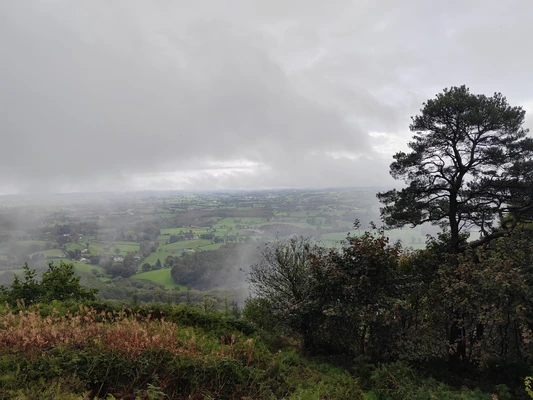
At the Top of the Hill in Knockmany Forest
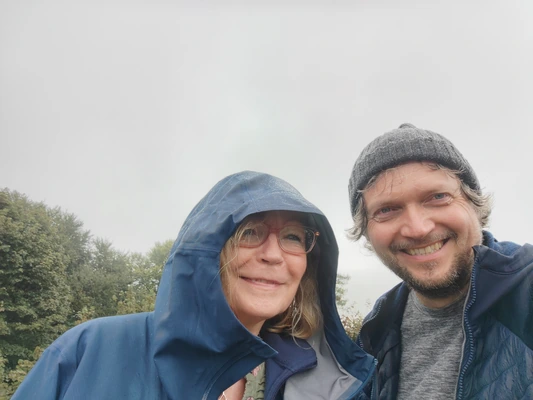
Despite the Rain the Mood is Great
The trip there lasted for an hour and half and we nearly reached Irish sea. Concretely, we were placed in the Rostrevor, a beautiful small town at the UK bank of Carlingford Lough. In fact, the accommodation encompasses the view on both sides of Carlingford Lough, as the invisible border line goes through the Lough. At the both sides, there are amazing mountains which, while is misty weather, look mystical. In this line, it does not surprise me that C.S. Lewis got the inspiration for ‘Chronicles of Narnia’ during a stay in Rostrevor.
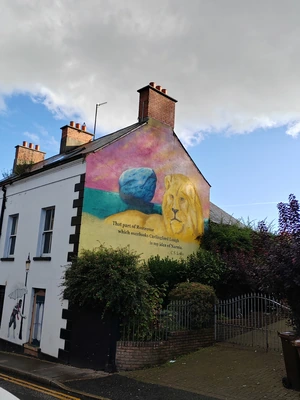
Mural in Rostrevor
Day 6 – Monday September 28, 2026
The morning in Rostrevor brought an interesting encounter with a local resident, also a member of a local action group focused on an environmental protection, as severe ecological risk relates to dangerous waste disposal on the Irish side of Carlingford Lough may induce ecological catastrophe. This conversation was a type of pre-interview for a follow up interview which will be conducted later. In this sense, during the entire week I was impressed how easily our PI Maggie implemented snowballing sampling strategy. In relation to the waste disposal issue, it was interesting to observe similarities with Croatian society as this is exactly the main topic in the public space in the latest months.
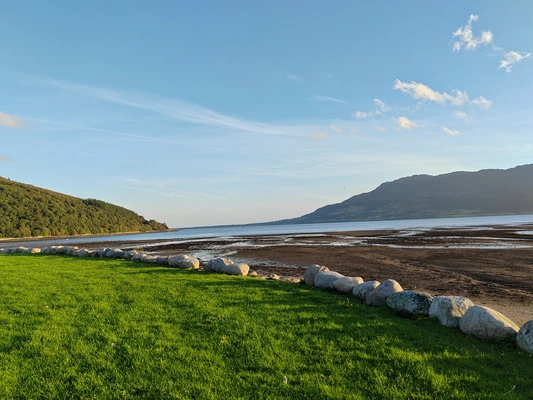
The View on Carlingford Lough
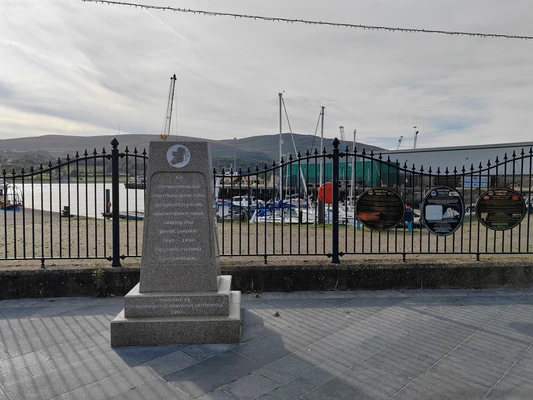
The Monument in Warrenpoint
The afternoon hours were devoted to an insightful ethnographic visit to the charming towns of Warrenpoint (UK) and Carlingford (Ireland). A frequent automatic shift of the mobile network from British and Ireland and vice versa gave me a sense of an interesting dynamics of borders in that, once again, extraordinary, beautiful landscape.
Day 7 – Tuesday September 29, 2026
The day of coming back to Croatia was reserved for a researcher’s self-reflection from which I would like to emphasize the 3 points.
- It is unique that once entering Ireland you can access UK (in Northern Ireland) without border check or showing ID at any point. The same holds for moving in another direction, indeed.
- When asking for a beer, there is no chance for misinterpretation, while asking for a ‘macchiato coffee’ reveals cultural differences, as only at one place in 6 days I really got ‘macchiato coffee’, which I asked for – in Croatian terms.
- The grass in Ireland is really green, and I emphasized that at the workshop. In the context of climate change, global warming, and long months without rain in Croatia where the grass is brown, the greenness of grass should not be taken for granted, as it highlights an environmental advantage of Ireland, which may only become visible when observed from the visitor’s eye.
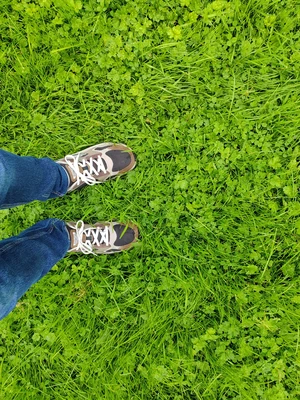
The Grass is Truly Green
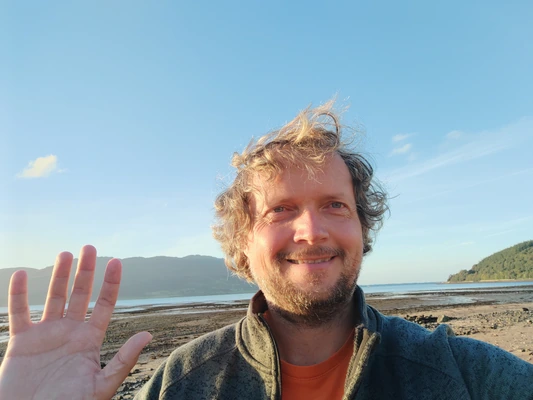
Sunset at the Carlingford Lough
On the flight back the Irish miracle has gone in a sense that I am not one hour younger anymore. But I am enriched with a precious research experience.