Blog
My experience as a research assistant at the EuroBorderWalks project
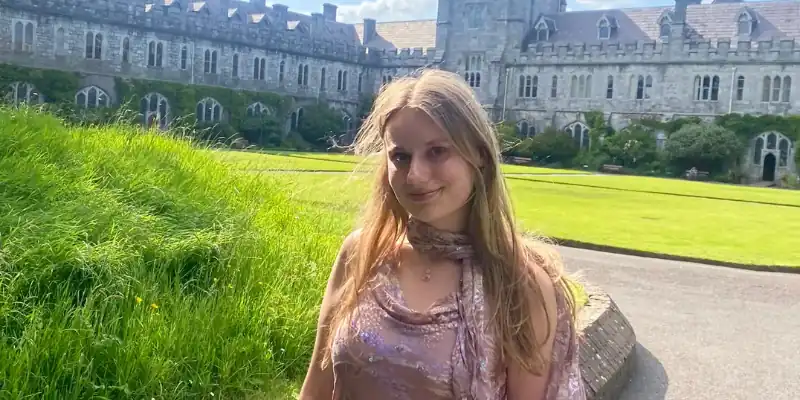
In this blog entry, Anna Katharina Priesterath reflects on the time she spent working as a research assistant on the EuroBorderWalks project.
Research in the social sciences is ever-evolving as societies are ever-evolving. In recent times, far-right anti-immigration pushes, hardening borders, and an increasingly individualistic society have prevented and sometimes even extinguished cross-border collaboration and communication (O'Connell, 2022). In times where solidarity, understanding, and empathy are crucial key components for living together, the community conversation and shared histories often do not happen and instead a silence is enforced collectively – enabling misunderstandings, assumptions and prejudices.
As a research assistant on the EuroBorderWalks I had the opportunity to not only increase my knowledge on the Ireland/UK border but I started to understand how questions of identity and belonging are never answered with a singular answer. The EuroBorderWalks project focuses on three EU/Non-EU borders, the Ireland/UK border, the Poland/Ukraine border, and the Bosnia and Herzegovina/Croatia border. Key takeaways from my time as a social science researcher has been the following: the issues we encounter and the problems we face are never fully unique but most probably have occurred or are occurring in a different context somewhere else in the world as well. Contexualisation is key and in order to understand the context, researchers must work with the research participants and not simply research about them. The approach taken by EuroBorderWalks project is participatory and involves walking as a biographical interview method and biographical narrative interviews as well as arts based workshops with research participants and artist responses to the research and their experience of the borderlands.
When I started my time on the project my main task involved supporting the writing of the literature review for the Ireland/UK border. While immersing myself in historical documents, timelines of the conflicts, and the field of border studies, I also had the chance to work with anonymised interviews given by research participants. The walking interview method enables participants to not only feel empowered and in control over the conversation but additionally helps to create a personal map of the border and what it means to live and/or grow up in the borderlands.
After I first arrived in Ireland almost two years ago, I started exploring the island and went to as many guided tours, museums, and events as possible. While the history of the famine was addressed a lot, also in conversations with colleagues and housemates, a lot of time the conflicts between the Republic of Ireland and Northern Ireland felt very far away and almost forgotten. When I started working in my first part-time job in Berlin at 17, I had a few customers that would ask me whether I am from the East or the West and I would reply that I am from Berlin, as the wall had been down decades before I was even born. It struck me how the border wall continued to live on in the older generation’s minds and I remembered those interactions when starting to work on the Ireland/UK border.
The field of border studies emerged around the 1980s and 1990s, not too long ago, and is continuing to grow as are tensions around the world. The increased wallification (Vallet, 2026) is creating more distance between people and the result of this is shown on the news every day.
The Ireland/UK border is often forgotten or declared ‘soft’ which ultimately ignores the trauma that can live on, the challenges some people remember, and others may face when crossing the border, such as in relation to visa status. Binary thinking about the border is problematic. Categorising people depending on their birthplace has been used as a system for centuries and unfortunately, continues to be a marker of people’s identities. This ignores the complex lived realities of people growing up in borderlands. Humans created borders. Borders, and sometimes border walls, are meant to ‘protect’ people from the other – the other being a group of people they deem dangerous, the unknown, or different. Borders can increase alienation more than they protect. They can mobilize fear of the other and increase division.
When coding anonymised interviews conducted by my supervisor Prof Maggie O’Neill I often felt taken back. I was reading through testaments of people who tried to understand what had happened and how they felt about the border. Decades after the Good Friday Agreement – which on paper was the end of the conflicts – some people in the borderlands (not all) continue to feel pain, loss, and confusion about the border.
Although each border researched on the EuroBorderWalks project is significant with its own history, social-political and cultural biography, they all share common traits and consequences such as trauma and for some, not all, collective silence replaces what could be open dialogue about what happened.
Border studies and migration studies are extremely important areas of research as they impact everybody. We are more mobile than ever in a time where mobility justice (Sheller 2018) is a privilege not everybody obtains. As part of my research, I attended several events, talks, conferences, and symposiums focusing on living in the borderlands, the establishment of borders, and the future of them. Many of the researchers carried their own family history into their research, aiming at shedding light on a past long ignored and/or forgotten.
I believe that talking to the people affected by geographical separation is crucial and should be the foundation for research conducted. This does not only apply to the border studies context. My time as a member of the EuroBorderWalks team was marked by many learnings – including the importance and possible ways to practice trauma-informed research, redefining interviews through walking and having participants map out their own route as a non-extractive and creative method and form of data collection, and understanding borders beyond the physical – which not only impacted my academic and professional work but also my personal life. Borders are impactful not only to those living in the borderlands but also the generations coming after.
Reproducing a single, one-layered narrative of what life at the border is like and what impact it has on people can be problematic. Lived realities are complex and must be listened to in order to understand borders and relationships. There are many forms of violence, and the non-physical ones are harmful too. Memories mirror the impact on people, and for collaboration and living with each other peacefully, we must listen.
These past seven months have been filled with hours of reading and writing but just as much dialogue as well. I am grateful to have been part of such an impactful and important project and am looking forward to being part of the conversation on borders and belonging as the project reaches a conclusion and findings are shared.
Bibliography
- O'Connell, R. (2022) 'Cross-Border Cooperation', in Fabbrini, F. (ed.) Law and Politics of Brexit: The Protocol on Ireland/Northern Ireland. Oxford: Oxford University Press.
- Sheller, M. (2018) Mobility Justice: The Politics of Movement in an Age of Extremes. London: Verso.
- Vallet, E. (2026) ‘A decade after “The (re)building of the wall in international relations,” the global wallification of the world’, Journal of Borderlands Studies. Available at: https://doi.org/10.1080/08865655.2026.2613670 (Accessed 17 May 2026).