Blog
Liminal Landscapes
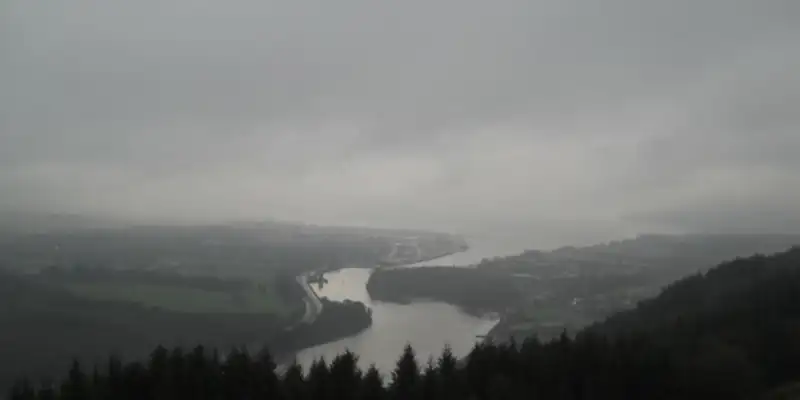
In this blog entry Conach Gibson-Feinblum tells reflects on a misty, morning walk through the countryside at the border between Northern Ireland and the Republic of Ireland.
After breakfast one Saturday, in January, with some free time on my hands, I decided to explore the countryside beyond the lodge where I had been staying to conduct fieldwork on the border between the Republic of Ireland and Northern Ireland with beekeepers. A soft, grey light filtered through the windows as I pulled on my runners and stepped outside. I’d heard there was a nearby viewpoint where you could see the stretch of water that separates Northern Ireland from the Republic, and curiosity drew me out to get a sense of the land.
The morning was decidedly dull; Storm Ingrid’s rain lashed down and wind rattled my car as I drove along what was once the main route across the border, lined with fireworks-for-sale signs, money exchange boards, and border vape shops, before turning off onto a road that climbed up the hill. The roads were slick with water, and at one point, a downed power line hung by the roadside, swaying in the storm’s grip and forcing me to swerve to the other side.
Upwards I drove, the road climbing ever higher until I reached an empty car park just off the roadside. I pulled in, the engine’s hum fading as I braced myself for the cold. My flimsy raincoat was no match for the chill, but I tugged it close and jammed a hat over my head for a bit of extra protection against the elements.
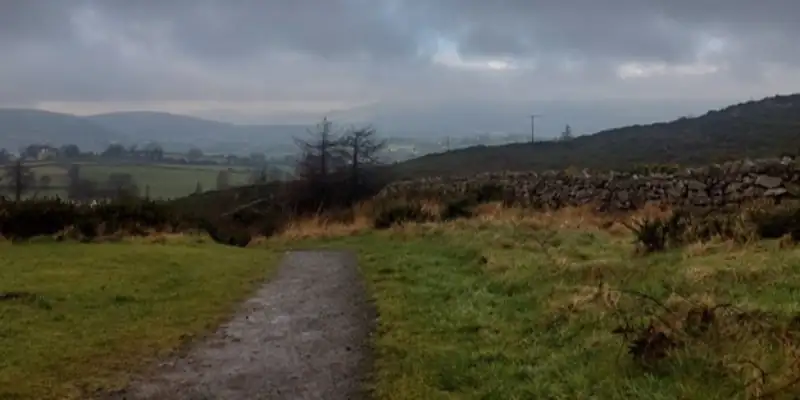
I climbed a dirt track up a small hill, slipping past puddles along the edges of the path, my runners squelching in the mud and I couldn’t help but thank my past self for stashing a clean pair in the car, already anticipating the relief of changing into them later. By the time I reached the top, admittedly not a long climb, though my lack of hiking experience made it feel otherwise, I paused to catch my breath and, in doing so, found myself noticing the world that had emerged as I gained elevation.
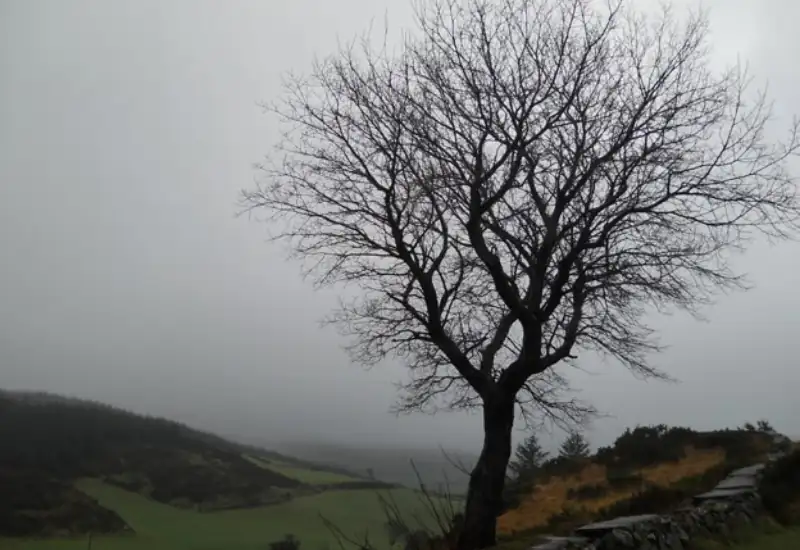
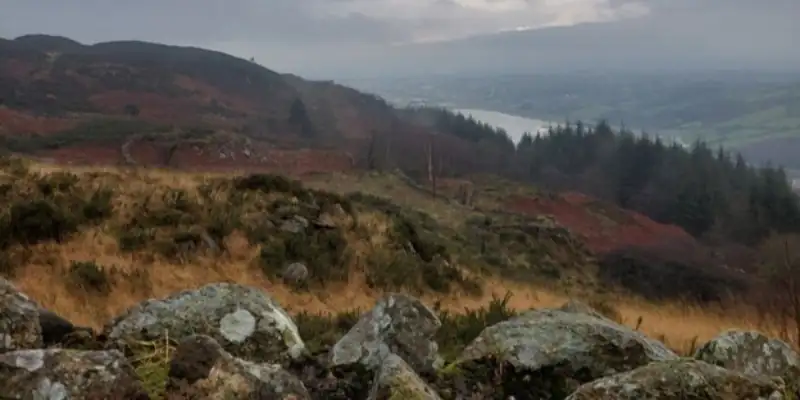
Spectral wisps of mist lingered around me, curling up behind the trees and sliding down the slope of the mountain, their presence so delicate as to seem almost imagined. And overhead, heavy clouds loomed in somber shades of grey, with only the faintest hints of light struggling through, never quite brightening the gloom.
My eyes traced the ground beneath the cloud and mist, where wild growth, uneven surfaces, and colour - deep greens, rusty earth, streaks of yellow, and weathered stone walls in shifting greys - all merged into a breathtaking scene, made all the more precious by its fleetingness, knowing I would never stand here again with the world arranged just like this, though I found myself hoping I might.
A bird called from the trees below. I stood on my tiptoes, peering over the stone wall, trying to spot it among the branches, but the little singer remained hidden, its song the only clue to its presence on the mountain with me. Other than that, I found myself utterly alone.
Left to my own devices, my mind slips easily into a world of mysticism and magic, a habit, perhaps, of a daydreamer, or of someone who has spent time among beekeepers who grew up with the myths, legends, and mysterious happenings of the land. I recall tales of churchyards and sightings of strange, looming figures in graveyards, and warnings against venturing out at twilight, a time believed to be when fairies and otherworldly beings were most active and mischievous. My thoughts wander further, to stories reaching back through the centuries to ancient heroes, like Cú Chulainn, whom I imagine standing firm against Queen Maeve’s invading army somewhere on these hills.
We have these beautiful places, these “thin places,” as Celtic tradition calls them, where the veil between the physical world and the spiritual, or otherworldly, realm feels especially delicate. In her book Thin Places, Kerrí Ní Dochartaigh beautifully describes thin places as locations that “make us feel something larger than ourselves, as though we are held in a place between worlds, beyond experience” (2022: 23). As my eyes follow the river winding its way toward the open ocean, my sense of enchantment is abruptly broken by the jarring silhouette of a building, marked by one of the deadliest incidents of the Troubles. The veil between worlds is suddenly thick and impenetrable.
I wish I could draw it back down, just to have a few more seconds to imagine what otherworldly beings might be slipping through the mist, but the moment slips away. In its place, the weight of history settles in. On the afternoon of 27 August 1979, two roadside bombs planted by the IRA exploded as a British Army convoy passed by, killing eighteen soldiers and I can’t help but dwell on it. I haven’t visited the site yet, but I know of it through beekeepers who remember that day, memories that are far from easy, and for some, painfully close, as they were in the area when it happened.
At times, I find it difficult to put into words the experience of working in places where breathtaking beauty, myths and legends, as well as wild growth lives side by side with historical trauma, violence, and loss. It’s one of the heavier tasks of fieldwork, to carry both wonder and grief at once. I turn my back to the water and make my way down the hill, allowing my thoughts to sit with me as I dodge the puddles once more.
It’s only now, on my way back to the car, that I notice a plaque and, intrigued, wander over to see what it might be. It turns out to be a tribute to generations of seamen (a testament to the area’s rich maritime heritage). At the bottom, an inscription in Irish catches my eye: Scarann an fharraige tíortha, chan anamacha (Ocean separates lands, not souls).
That simple line puts words to what I’ve been carrying inside: as humans, we may draw borders and divide lands, but they cannot always contain our spirits or limit our ability to connect, to care, to dream, and to find meaning with others. I see this in the way beekeeping brings people together across all sorts of borders, and I celebrate what becomes possible when we have the capacity to cross those boundaries.
Still, I’m aware that not everyone is as fortunate; how we experience borders depends greatly on our circumstances. For many, the ability to cross borders is not just difficult, but can be dangerous or even life-threatening. And so, I’m reminded of the privilege I carry and how easily I can move where others cannot.
*As part of the EuroBorderWalks project, Conach Gibson-Feinblum’s doctoral research explores how the border between Northern Ireland and the Republic of Ireland is experienced, practiced and understood through the lives and practices of beekeepers, using a combination of ethnographic, biographical and arts-based research.
References
- Ní Dochartaigh, K. (2021) Thin Places. Canongate Books.
- O’Neill, M. (2001) Prostitution and Feminism: Towards a Politics of Feeling. Cambridge: Polity Press
All images in this blog by Conach Gibson-Feinblum.