
Blog
Between Hives and Borders: Beekeeping Along the Irish Border - Conach Gibson-Feinblum
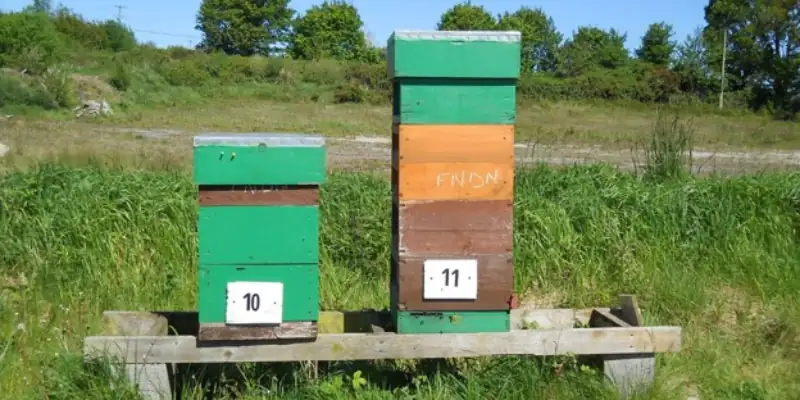
As part of the EuroBorderWalks project, my doctoral research explores how the border between Northern Ireland and the Republic of Ireland is experienced, practiced and understood through the lives and practices of beekeepers, using a combination of ethnographic, biographical and arts-based research (an approach called ‘ethno-mimesis’ by Professor Maggie O’Neill.
Beekeeping on the island of Ireland dates back to ancient times, with its importance captured in early Irish legal texts, known as the Brehon Laws. These laws, which governed Irish society for centuries, included detailed rules about the ownership of bees and the responsibilities of beekeepers.
Today, beekeeping is as much about community as it is about the bees themselves. People from all backgrounds come together, united by a shared passion. Beekeeping is inherently social and collective, flourishing through shared experiences, knowledge exchange, and collective action.
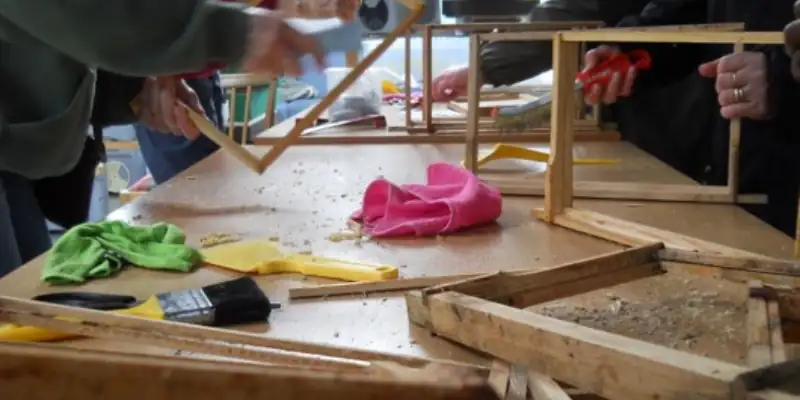
Image: Conach Gibson-Feinblum. Club members working together to make brood frames, which need to be ready before the hives are opened. We began by scraping off dirt and old wax from the wooden frames, then passed them to the next station, where someone attached a new foundation. Afterward, the frames were placed in a brood box, ready for use in the hives.
My research aims to reflect this collaborative and participatory ethos. Working alongside a cross-border beekeeping group as a community partner, I approach fieldwork as a way of learning with others, both human and nonhuman, and remaining open to being shaped by the experiences, relationships, and encounters that arise along the way, as inspired by Tim Ingold.
Adopting Donna Haraway’s feminist epistemology of ‘situated knowledges’ is particularly well-suited to this research, given that I am working in a context where people’s lives and experiences, while often sharing important similarities, can also differ significantly from each other and from my own, especially as I am neither from the border region nor part of the beekeeping community (though I grew up with beehives in my backgarden).
Through walking interviews as a biographical method (WIBM), autobiographical narrative interviews, and participant observation, we have visited a multitude of sites on both sides of the border, from windy mountain tops where bees graze six or seven times a year to sandy beaches where coal from a long-ago shipwreck still washes ashore. Along the way, we have explored themes such as control, surveillance, and power at the border (including state, non-state, and gendered dynamics), given that the Irish border was once a highly militarised zone; resistance and subversion; mobility and daily routines; cross-border and cross-community friendship and learning; and the significance of third places.
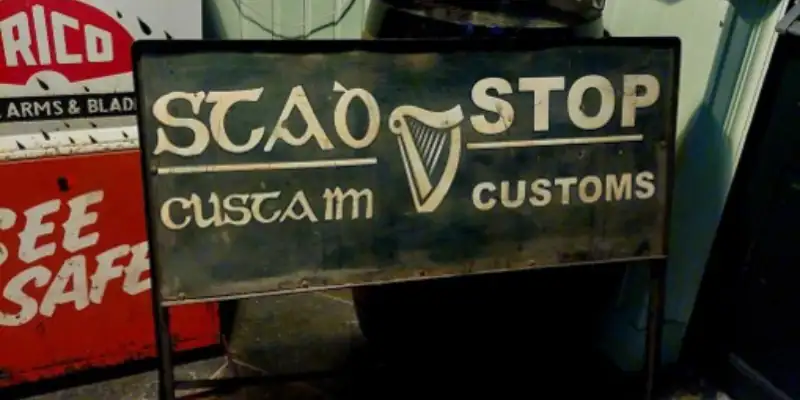 Image: Conach Gibson-Feinblum. An old customs signpost, once a common sight along the border between the Republic of Ireland and Northern Ireland. After the signing of the Good Friday Agreement in 1998 and the subsequent easing of border controls, most customs checkpoints and their associated signage were dismantled or fell into disuse.
Although this research begins and ends with the border, our conversations and observations go beyond just human experiences to include relationships and interactions with the more-than-human world. After all, borders and borderlands are sites where humans, animals, plants, and even things like fossil fuels all have agency, interacting and influencing outcomes through their ongoing relationships (Ozguc and Burridge, 2023). We draw on the concept of “becoming-with,” associated with Donna Haraway, exploring topics like the importance of wild growth and reconsidering our attitudes toward weeds, appreciating the crucial support they provide for pollinators, for example.
In the company of beekeepers and the more-than-human world, what I did not know became an invitation: to learn, to connect, and to be changed. I am deeply indebted to the beekeepers, the land, the trees, the bees, and the fungi, all of which have taught me about entanglements and co-creation, and have offered insights into places, histories, and stories I could never have learned on my own. I am also grateful to the EuroBorderWalks team and my supervisors[1] for their steady support and guidance, which have been central to my learning and development throughout this project. As Donna Haraway reminds us, “becoming-with, not becoming, is the name of the game” (2016: 12).
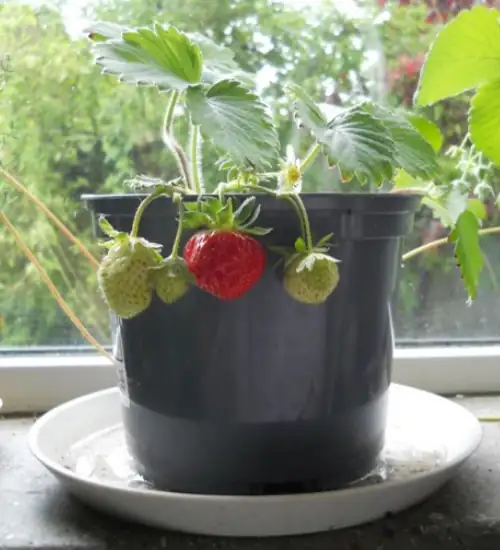
Image: Conach Gibson-Feinblum
I received this strawberry plant as a gift from two beekeepers after I mentioned my interest in gardening, but admitted I lacked a greenhouse or much experience. They told me stories of growing strawberries, leeks, and tomatoes not in gardens or greenhouses, but on windowsills and in kitchens. So now, I grow strawberries on the little sill above my sink. Watering and watching the plant grow has made me feel more grounded and connected to the earth, as Alastair Humphreys writes, “Nature is all around us. We are in nature. We are nature” (2024: 44). Inspired by this, I’ve started growing chillies, and I’m looking forward to one day having a greenhouse so I can grow more, grow better, and grow for longer.
[1]Professor Maggie O’Neill, Dr. Tracey Skillington, and Dr. Michael McLoughlin.
References
- Haraway, D. J. (1988) ‘Situated Knowledges: The Science Question in Feminism and the Privilege of Partial Perspective,’ Feminist Studies, 14(3), 575-599.
- Humphreys, A (2024). Local: A Search for Nearby Nature and Wildness. Eye Books.
- Ingold, T. (2014) ‘That’s enough about ethnography!,’ HAU: Journal of Ethnographic Theory, 4(1), 383–395.
- Ingold, T. (2017) ‘Anthropology contra ethnography,’ HAU: Journal of Ethnographic Theory, 7(1), 21–26.
- O’Neill, M. (2001) Prostitution and Feminism: Towards a Politics of Feeling. Cambridge: Polity Press.
- O’Neill, M., and Roberts, B. (2019) Walking Methods: Research on the Move. London: Routledge
- Ozguc, U., and Burridge, A. (2023) ‘More-Than-Human Borders: A New Research Agenda for Posthuman Conversations in Border Studies,’ Geopolitics, 28(2), 471–489.