
Policy Framework for UCC Digital Badges
Contents
Version
Version: 2.1
Review date: 13 February 2025
Policy Owner: Chair of the Digital Badge Subcommittee
Approved by: Academic Board, 25 October 2017. (Digital Badge Committee review and edits 12 February 2025)
Introduction
This Policy Framework is a document that sets direction, objectives, standards, policy and process for the development of digital badges in the University. The purpose is to ensure that a robust quality and standard is met by all digital badges issued by UCC. Within UCC, a digital badge is a validated micro-credential awarded to earners in an online format. It is a means for the university to recognise small pieces of non-accredited learning that support the values and attributes the university seeks to foster. A digital badge is awarded by the university once an earner demonstrates competence in pre-agreed learning outcomes.
Objectives of the Policy Framework
The objectives of the Policy Framework are:
Objective 1 – To provide a Strategic Approach to developing the organisation and navigation of UCC Digital Badges, enabling the strategic development of emerging longer-term opportunities for digital badges within UCC;
Objective 2 – To put in place a clear Governance and Operational Policy for immediate use in the development and issue of externally facing, non-credit bearing digital badges; and,
Objective 3 – To ensure UCC Digital Badge Quality and Standards through implementing an Approvals Process for immediate use to progress the development and issue of any new digital badges by UCC.
Scope of the application of the Policy Frameword
The priority application of UCC Digital Badges in the immediate term is envisaged as being primarily for non-credit bearing activity. The scope of the application of this Policy Framework is therefore the development and issue of externally facing UCC Digital Badges issued as a means of recognising knowledge and skills obtained outside of or complementary to the ECTS credit system, delivered at no additional cost to the earner and not resulting in monetary gain for the badge issuer. These badges can be issued to UCC staff and students.
It is recognised that many potential staff activities may be classified as Continuous Professional Development (CPD) and that digital badges may be a useful tool of recognising both credit and non-credit bearing CPD. It is also recognised there may be opportunity for future application for the use of digital badges as a tool to support student assessment and progression activity. This may be of interest to adults returning to education through ACE.
This Policy Framework, therefore, does not preclude uses or application of digital badges beyond this scope, but considers that alternative, supplementary or additional policy or procedures may be required to support such uses. The opportunity for other uses will be considered and progressed by the Digital Badge Sub Committee under their remit to oversee the overall strategic development and governance of the digital badges issued by UCC.
Section 1: Strategic Approach
Objective 1 – To provide a Strategic Approach to developing the organisation and navigation of UCC Digital Badges, enabling the strategic development of emerging longer-term opportunities for digital badges within UCC.
The strategic approach is to create the right conditions and an enabling environment that can realise the long-term opportunity for digital badges within the University. Strategic actions will be developed and progressed in line with the following guiding principles:
- Relevant and Accessible Life Wide Learning – the organisation and navigation of badges will facilitate accessible, positive learner experience and life wide learning. Potential earners should be able to easily access, explore, earn and share relevant skills and knowledge.
- Aligned to UCC Strategy - the organisation and navigation of digital badges will align with the strategic plan, goals and initiatives of the University, recognising and demonstrating the University’s strategic focus in practice. Projects necessarily progress at different paces; however, the guiding principle will be to avoid ‘designing out’ potential for future alignment with other ongoing strategic initiatives in UCC.
- Agile and Flexible Eco-system – to enable the growth of an innovative digital badge eco-system in UCC, strategic development will be agile in approach. It will facilitate the development of learning pathways and be developed in a phased and iterative approach. Where possible, strategic development will provide for integration with future systems such as the new student administration system, virtual learning environment or digital hub.
- User Experience and Communications – communication will be key to building an intuitive navigation experience, strong take-up and externally reputable digital badges. A guiding principle is that the user experience and communications are a key focus for strategic development, where the value of digital badges can be understood within the context of the wider services and supports available to UCC staff and students.
The strategic approach will be driven by the Digital Badge Sub Committee (DBSC) of the Academic Development and Standards Committee (ADSC). As of June 2020, the Open Badge Factory platform managed by the Centre for Digital Education is the current platform used to develop and issue Digital Badges to earners; however, as digital badges and systems develop, this may migrate to a different system.
1.1 UCC Digital Badges Project Pages / Website
The Digital Badge Project pages are currently housed under the CDE SharePoint Communications website. (UCC staff access only)
Section 2 Governance and Operation Policy
Objective 2 – To put in place a clear Governance and Operational Policy for immediate use in the development and issue of externally facing, non-credit bearing digital badges.
This section describes the governance and operational policy for how the development and issuing of digital badges will be managed in UCC. All badges issued by UCC must adhere to this policy.
2.1 Roles and Responsibilities - Transparency and Accountability
2.1.1 Digital Badge Sub Committee (DBSC)
The Digital Badge Sub Committee (DBSC) was formally established and is responsible to the ADSC for the oversight, development and implementation of policies and procedures related to the issuing of digital badges by UCC as well as the assurance of quality, standards and compliance with relevant data protection legislation The DBSC will operate in line with the Policy Framework for UCC Digital Badges and be governed by the appended Terms of Reference. The purpose of the DBSC is:
- to manage the overall governance and strategic development of UCC Digital Badges;
- to oversee the implementation of the Policy Framework for UCC Digital Badges;
- to approve the development and issuing of digital badges by UCC in line with the approval process, Standards and Digital Badge Assessment Rubric; and
- to inform and make recommendations to the ADSC in relation to the effective management and governance of UCC Digital Badges.
2.1.2 Badge Issuer and Badge Contact
The Issuer (e.g. School, College, Department, Student Union) and Coordinator (person nominated as contact by Issuer) developing and delivering a UCC Digital Badge. They are responsible for:
- Completing the Digital Badge Application Form and submitting it as a proposal for a new badge to the DBSC;
- Ensuring UCC Digital Badges are delivered to standards in line with the Policy Framework and Approvals Process and in line with their approved Digital Badge Application Form;
- The delivery and administration of badge learning content, activity and evidence that learner criteria have been met; and
- The submission of the Digital Badge Application Form and Digital Badge Recipients Form to the DBSC for approval. The Badge Coordinator is ultimately responsible and accountable for meeting the relevant quality and standards associated with their badge. The Badge Coordinator should be a staff member with an appropriate level of authority and responsibility.
2.1.3 Digital Badge Administration
The Digital Badge Administration will be a function of the Centre for Digital Education in the office of OVPLT. They are responsible for:
- The management and coordination of the Open Badge Factory platform used by UCC for the issuing and validation of digital badges;
- Updating the Digital Badge project page and issuing digital badges to earners confirmed to have met criteria by the Badge Contact;
- Advice and guidance to badge applicants and DBSC to ensure quality and standards e.g. considering issues such as data protection, plagiarism, duplication; and
- The procurement and terms of agreement of the UCC account with any third-party service providers used for the dedicated purposes of the digital administration of digital badges.
2.2 Governance
2.2.1 The Digital Badge Sub Committee (DBSC) will be governed by a Terms of Reference (TOR) approved by the ADSC. The membership and TOR will be reviewed annually.
2.2.2 The DBSC will meet as needed to approve the development and issue of new UCC Digital Badges. It is important that digital badges issued by the University are perceived as meaningful indicators of learning and therefore must be linked with evidence of learning, participation, engagement and/or achievement. The DBSC will use the Digital Badge Assessment Rubric to review all submissions as assurance that they meet Quality Standards. They may reject an application, request further information or make recommendations to ensure all digital badges issued by the University are robust, of a high calibre and in line with the University’s strategy.
2.2.3 All badges issued will have a nominated Badge Coordinator of appropriate level within the organisation to ensure appropriate accountability of standards in delivery. All Individuals and groups from within the University, whether staff or student, are eligible to submit proposals for developing digital badges, but badges must be authorised and ‘owned’ by an appropriately senior staff member. University staff and students who wish to issue digital badges e.g. Heads of Colleges/Discipline, module coordinators, training providers, Students’ Union, UCC Clubs and Societies etc. are responsible for knowing the applicable policy, standards and guidelines for the development and delivery of digital badges in UCC and understanding their role and responsibilities.
2.2.4 As part of the strategic development work of the DBSC, the University will engage informative communications to raise awareness of digital badges both internally to staff and students, and externally to employers, recruitment agencies, professional bodies etc.
2.2.5 The DBSC retains the right to revoke a digital badge if just cause is established. If for any reason the University finds it necessary to revoke a badge, this is also possible through the digital badge platform.
2.2.6 Issues, appeals and complaints will be directed to the ADSC in the first instance.
2.3 Digital Badge Development and Issue
2.3.1 Externally facing Digital Badges will reflect skills, attributes or behaviours that are recognised by the University and are deemed significant enough to be shared online via a person’s CV, social media, website, ePortfolio etc.
2.3.2 External collaboration and endorsement will be clearly stated and described. UCC Digital Badges that are earned in collaboration with other institutes, professional bodies, companies or organisations can be issued. For example, a student is issued with a digital badge for carrying out work with a company. This company's logo (with permission), could also be used in the digital badge design to demonstrate their endorsement of the student. The level of engagement of any second company/organisation collaborating with or endorsing the badging process would need to be clearly reflected in the digital badge template, criteria and description.
2.3.3 All digital badges issued by UCC must align to the UCC’s Strategic Plan 2023 – 2028, UCC’s Graduate Attributesand the University’s Core Values.
2.3.4 All digital badges issued by UCC will use the standard UCC Digital Badge design approved by the Office of Marketing and Brand Impact in accordance with the University’s Visual Identity Guidelines.
2.3.5 To ensure quality and consistency of digital badges issued by UCC, every badge must be delivered through the Approvals Process. Proposals for the development of a UCC Digital Badge will be progressed through the Approval Process using the Digital Badge Application Form and Digital Badge Recipients Form.
2.3.6 All required components of the badge will be outlined in an approved Digital Badge Application Form.
2.3.7 The proposed delivery and meta-data for the UCC Digital Badge will be approved as meeting Quality Standards for UCC Digital Badges by the DBSC at the first in line with Approval Process, Quality Assurance Standards and Digital Badge Assessment Rubric.
2.3.8 If the Digital Badge Subcommittee has any queries, this will be communicated via email and amendments can be made in the Digital Badge Amendment form.
2.3.9 The Chair will then consider replies on behalf of the subcommittee and decide on whether to approve or reject updated applications, or refer the matter back to the subcommittee for further discussion.
2.3.10 A validation that there is appropriate assessment and evidence of earners meeting the agreed criteria will be captured using the Digital Badge Recipients Form.
2.3.11 UCC Digital Badges issued will have a clear expiration date. Depending on the type of digital badge issued, some badges should expire after a certain amount of time, usually once they are no longer of significant value to the earner as they have gained other, more extensive experience elsewhere i.e. in the workplace, professional bodies, organisations etc. Another example of a badge lifespan is training that should be repeated after a certain period e.g. health and safety courses that need to be completed every two years. All digital badges will have a clear expiration date.
2.4 Information for Badge Earners
2.4.1 Badge Issuers will promote their digital badges and ensure potential earners are supported to make informed choices and are provided with enough information about their badge and its use.
2.4.2 An earner’s email address is required to validate their digital badge. This forms part of the metadata for the digital administration and validation of a digital badge for the earner. The email address serves as the unique identifier to facilitate recipients to access and share their digital badges. Badge Earners will be informed about how their personal data will be stored and used.
2.4.3 A staff member or student can collect digital badges from several sources including but not limited to their academic unit, organisations within UCC, training bodies, the Students Union and/or clubs and societies. As students/staff collect badges they build their personal and professional development profile.
2.4.4 Once a Digital Badge has been validated and provided to the Badge Earner, the metadata of that badge cannot be changed by a third person or even by the Badge Earner. It is at the earner’s own discretion if they want to share their email address or that badge with third parties.
2.4.5 When these digital badges are shared online they are clickable, and link back to a webpage with the meta-data on the badge including the issuer, a general description, the specific criteria that the earner met to be issued the badge and importantly the earner who was issued the badge. This metadata makes the badge secure from plagiarism/duplication.
2.4.6 The DBSC retains the right to revoke a badge if it is displayed inappropriately as part of an online profile. All Open Badges issued by the University have a "Verified by Open Badge Factory" mark. This ensures that if an individual was to plagiarize and wrongly display a badge as part of their online profile, this could be verified and action against the individual to remove this badge from their profile initiated.
2.5 Digital Badge Learner Content and Activity
2.5.1 This Policy Framework does not aim to replicate or replace QQI or other policy and guidance that is already available and generic to all teaching and learning or curriculum design (for example) – whatever the mode of delivery.
2.5.2 Badge Issuers will demonstrate the rationale and value of their digital badge and identify the intended learning outcomes.
2.5.3 Badge Issuers will look for the most effective and efficient means to support learners in achieving intended badge criteria and ensure equitable and fair opportunity and accessibility.
2.5.4 Badge Issuers will ensure the delivery system for each digital badge is fit for its purpose and delivered using suitably designed materials, interactive learning and other relevant supporting resources.
2.5.5 Badge Issuers will ensure badge learning content and activity is supported by fit-for-purpose resources, organisation and process in areas such as the recruitment of potential earners, delivery of learning and learning evaluation, feedback and assessment.
2.5.6 A standard digital badge should reflect approx. 20 to 30 hours of effort by the earner, ideally 25 hours, and must include the production of at least one artefact by the earner.
2.6 Digital Badge Administration
2.6.1 All UCC Digital Badges will be digitally administrated by the Centre for Digital Education, part of OVPLT.
2.6.2 All badge administration conforms to UCC’s obligations under General Data Protection Regulations (GDPR).
No sensitive third-party data will be shared in the issue of UCC Digital Badges. To issue digital badges, one must collect personal information, mainly email addresses, which can be shared with the digital badge platform UCC will be issuing the badges from (currently Open Badge Factory). This platform does not store any other personal information from the Badge Earner other than their email address. The platform does not disclose that information to third parties unless with express permission from the University or under a request by representatives of law enforcement. The University will only share theemail addresses of Digital Badge Earners with the digital badge platform and maintain any records pertaining to digital badges in accordance with GDPR obligations.
2.6.3 The Centre for Digital Education will ensure a planned approach to the procurement of services to support digital badges and contingency arrangements in the event of platform, hardware or software failures.
2.6.4 The Centre for Digital Education will ensure the availability and life expectancy of the technology is appropriate to the nature of the provision, numbers of earners and strategic development of UCC Digital Badges. Institutionally approved transitional arrangements are in place to support any migration to new or different technology (hardware or software), taking account of the need to maintain compatibility with the technology that learners are using.
2.6.5 The Centre for Digital Education will maintain an internal central record of email addresses for all validated digital badges earners in perpetuity for the purposes of verifying earners at future dates. Open Badge Factory, by necessity, maintains a list of badge earners’ email addresses for the purpose of credential validation.
2.6.6 The Centre for Digital Education will report on the number of digital badges issued and an annual report to the DBSC to monitor and evaluate the effectiveness and take up of UCC Digital Badges.
Section 3 - Digital Badge Quality and Standards
Objective 3 – To ensure UCC Digital Badge Quality and Standards through implementing an Approvals Process for immediate use to progress the development, approval and issue of any new digital badges by UCC.
This section outlines:
- The Quality Assurance Standards that every digital badge must demonstrate across its critical component parts.
- The Approval Process that every UCC Digital Badge must go through from concept development to approval through to issue of badges to earners. This process is supported by the appended standard forms and templates i.e. Digital Badge Application Form; Digital Badge Recipients Form and Digital Badge Assessment Rubric.
3.1 Quality Assurance Standards
This Policy Framework determines that there are four areas of quality assurance across which every UCC Digital Badge must meet agreed criteria in their design and delivery.
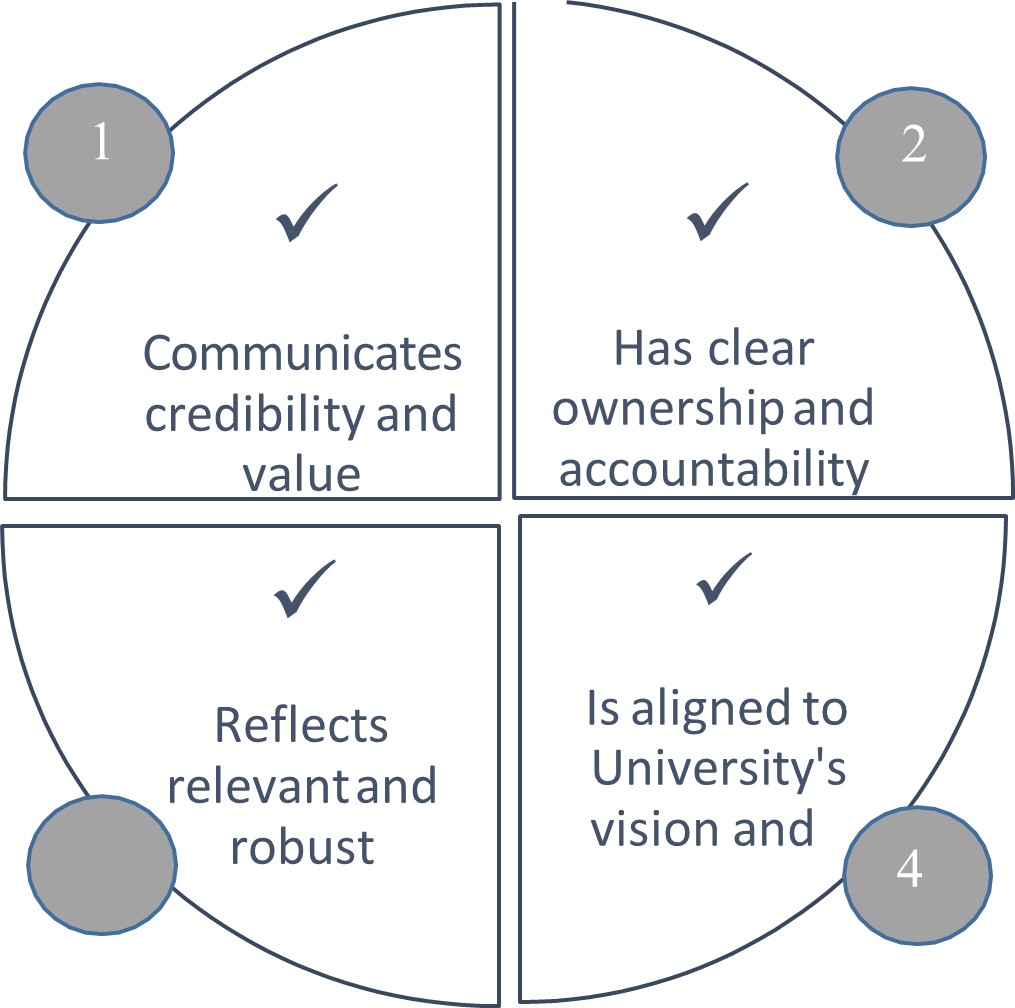
- Communicates credibility and value
- Has clear ownership and accountability
- Reflects relevant and robust learning
- Is aligned to University's vision and strategy
3.2 Approvals Process
There are two approvals for the development and delivery of UCC Digital Badges.
1 – Badge Development
The first ensures that the design and planned delivery for the digital badge meets the required standard. Proposals for a new digital badge will be submitted as a proposal for review to the DBSC using the standard Digital Badge Application Form. This form ensures that potential Badge Issuers consider and respond to all standards at the early planning stage. A Badge Assessment Rubric will be used by the DBSC based on the Quality Assurance Standards and associated criteria for assessment to approve progression to the development and delivery of the badge content and activity.
2 – Validate Earners
The second assures that the badge has been delivered in line with the approved plan and that Badge Earners have met the required criteria. At this stage, the Badge Coordinator, on behalf of the Badge Issuer, signs off on delivery and request approval for the digital administration to issue badges to validated earners using the Digital Badge Recipients Form.
Glossary
Definitions of Key Terms Used for the Purpose of this Policy Framework
UCC Digital Badge - Within UCC, a digital badge is a validated micro-credential awarded to earners in an online format. It is a means for the university to recognise non-accredited learning that support the values and attributes the university seeks to foster. A digital badge is awarded by the university once an earner demonstrates competence in pre-agreed learning outcomes.
UCC Digital Badge Eco-System - The ‘family’ of digital badges developed, designed and issued by UCC.
Badge Design - The picture or visual representation used on-line to reflect the skill or area being recognised.
Badge Development - The work involved in the planning and development of a digital badge (design, content, activity and digital administration) undertaken by the Badge Issuer/Contact with the support and guidance of the Digital Badge Administration team.
Badge Earner – the person receiving a digital badge.
Badge Issue - The total activity involved in the delivery of a digital badge for a skill or area, including all component parts from design, content, activity, evidence of criteria met and validation. Multiple badges may be issued from separate groups within UCC concurrently.
Badge Issuer - The academic unit or functional area which is awarding an approved digital badge.
Validated Digital Badge - The unique allocation of an individual digital badge, issued to learners who have successfully met the digital badge criteria. Recipients of validated digital badges have been confirmed to have met required criteria and have been provided with access to their (uniquely allocated) digital badge for use across social networking websites, ePortfolios, job sites and on their CVs.
Learning Outcomes - Statements that are used to express what the students are expected to achieve and how they are expected to demonstrate that achievement. Learning outcomes are essential for badge validation and verification.
Meta Data - The primary data fields required for the digital administration. This meta data is linked to the badge and cannot be changed. This is critical to badge security and verification of issuer, earner and the criteria they achieved to be issued the badge.
Badge Description / Badge Content and Activity - The description of the learning content activity that will be delivered to enable the badge earners to meet the proposed badge criteria.
Evidence – The artefact and/or activity that will serve as record that the earner has met the badge criteria. The evidence will enable appropriate assessment of learning, engagement and participation in the digital badge content and activity.
Quality Assurance Standards – The critical component parts of the UCC Digital Badge design, development and delivery used to manage quality and standards in UCC Digital Badges.
Digital Badge Administration - The management and coordination of the Open Badge Factory platform used by UCC for the issuing and validation of digital badges
Badge Issuer or Badge Contact - A named person within the academic unit or functional area which is awarding an approved digital badge.
Digital Badge Sub Committee - The group established with responsibility for the overall governance and strategic development of digital badges issued by UCC. It is a subcommittee of UCC’s Academic Development and Standards Committee. The Digital Badge Sub Committee also serves to approve proposals for new UCC Digital Badges to be issued in line with Quality Assurance Standards.
Digital Badge Pathway – A learning pathway or route, taken by a learner through a range of digital badges, which allows them to build knowledge progressively.
Appendix B - Digital Badge Recipients Form
Digital Badge Recipients Form (Live online version)
Appendix C - Digital Badge Assessment Rubric
Digital Badge Assessment Rubric (Downloadable PDF)
1. Clear Ownership and Accountability
| Badge Name |
The UCC Digital Badge title will be succinct and accurately reflect the learning, achievement, skill or area that the UCC badge is recognising. |
| Badge Coordinator |
The Badge Coordinator will be a UCC staff member with senior decision-making authority such as Head of College or similar. |
| Badge Issuer |
The Badge Issuer must be a recognised group, college, discipline, department, module coordinator, training provider, office, club, society or campus company of the University. |
| Approval |
Approval is required from the Head of School or equivalent. |
| Evaluation Criteria for Assessment |
□ Badge name and badge issuer areclear. □ Appropriate level Badge Coordinator. □ Approval has been given. |
2. Aligned to University's Vision and Strategy
| Rationale |
Badge Issuers will demonstrate a clear rationale for the use of a UCC Digital Badge to recognise accomplishment. The rationale must demonstrate that the badge responds to an identified need, enhances the user experience or provides a unique value add opportunity. |
| Target Earners |
Badge Issuers will clearly identify the target earners of the digital badge and have a clear focus on the earner experience i.e. who is the badge for? Why will they want to earn the badge? What opportunity does it unlock for the earner? |
| Strategic Alignment + Integration |
Digital badges need to be aware of the wider eco-system of digital badges and avoid duplication. Where relevant potential badge issuers should collaborate with other Badge Issuers to ensure integrated approaches for recognition of similar accomplishments. UCC Digital Badges must demonstrate that they are aligned to the University’s Strategic Goals and Values. |
| Description |
A brief overview of the badge, mentioning its purpose and audience will be provided as part of the meta-data for the badges digital administration and published information associated with the badge. This cannot be changed once the badge is created and is an important to external viewers wanting to verify a validated badge. The description will be of an appropriate quality and standard for this use as wider publication and verification of badge by external audiences. |
| Learning Outcomes |
Each badge will recognise accomplishment by identifying four learning outcomes that the earner must meet. Learning outcomes are statements that specify what learners will know or be able to do because of participating in the badge content and activity. Bloom's taxonomy provides useful guidance on appropriate verbs for writing learning outcomes. Verbs that are vague and not observable or measurable should be avoided. |
| Duration |
Badges relate to a time-set, event or piece of work that is likely to change. Therefore, the maximum duration of a badge can be 5 years. |
| Learner Pathways |
Badges can be linked with various levels of accomplishments or aligned competencies. Badges should demonstrate that consideration has been given to potential future badge pathways that support learning trajectories. |
| Evaluation Criteria for Assessment |
□ Rationale - Badge responds to an identified need, enhances the user experience or provides a unique value add opportunity. □ Target earners clearly identified and strong focus on the earner experience and value to Badge Earner. □ Description is appropriate for on-line publication and suitable for external audiences wishing to verify information about the badge. □ Badge has considered the wider eco-system of badges, demonstrating integration, avoidance of duplication and potential learning pathways. □ Badge duration is appropriate. □ Four badge criteria are identified that are measurable statements that specify what learners will know or be able to do because of participating in the badge content and activity. □ Badge has been ‘mapped’ to appropriate values and knowledge and skills zone. □ Four badge tags identified. |
3. Reflects Relevant and Robust Learning
| Content and Activity |
A single digital badge should reflect approx. 20 to 30 hours effort by the earner. A clear methodology for the delivery of badge content and activity should be outlined, whether face-to-face, on-line or participation in other activity. |
|
|
Content and activity should be supported by appropriate tools, resources and information. |
| Assessment |
Badge Issuers should clearly demonstrate how they will assess or evaluate that the learning outcomes have been met. |
| Evidence |
Badge Issuers should identify what evidence will be used to demonstrate that the learning outcomes have been met. This must include at least one artefact produced by the earner, e.g. blog, short reflection, presentation, poster. |
| Access, availability and resources |
Badge issuers should demonstrate how they will ensure equal opportunity for access and availability of the badge to target earners. They should also demonstrate commitment to the capacity and resources to manage and deliver the content and activity outlined. |
| Evaluation Criteria for Assessment |
□ Robust content and activity demonstrated. (c.20 to 30 hours learner effort). □ Clear plan for assessment and evidence that learning outcomes have been met including at least one artefact to be produced by Badge Earner. □ Badge is available and accessible. □ Demonstrates commitment to resources required for delivery. |
4. Communicates credibility and value of accomplishment
| Badge Design |
All badges will use the standard UCC Badge Design template. Badge Issuers should identify an appropriate logo/icon and title text to be used in the badge design. |
| Tags |
All badges will identify a least four key tags that will assist on-line navigating, searching and finding of digital badges. (e.g. #Technology), the knowledge or skill (e.g. #Innovation), the target earner (e.g. #student) and the Badge Issuer (e.g. #Student Union). |
| Promotion |
There should be a clear plan in place for the promotion and advertising of the digital badge to target earners. |
| GDPR |
Badge issuers should demonstrate how the administration of this badge will meet UCC GDPR compliance obligations. |
| Evaluation Criteria for Assessment |
□ Information for badge design and tags provided. □ Demonstrates how the badge will be promoted / take-up, encouraged. □ Demonstrates effective communication, information provision and engagement with Badge Earners. |
Appendix D - Proposal for Amendment to Digital Badge Application
Proposal for Amendment to Digital Badge Application (Downloadable PDF)
| Badge Name | |
| Who is issuing this UCC Digital Badge? | |
| Date Original Badge Approved by DBSC | |
| Badge Coordinator Name | |
| Badge Coordinator Email Address | |
| Approval for Amendments | |
| Please provide details of proposed amendments to original digital badge application: | |
| Please provide link to copy of original application with proposed changes highlighted in red. | |
| Agreements | Have all changes been agreed with any non-UCC organisations or people involved in the delivery of the badge? o Yes o No |
Policy Document Index
| 1. UCC Digital Badge Sub Committee Terms of Reference | Live online |
| 2. UCC Digital Badge Application Form Description: Standard template for those interested in developing or issuing a badge to complete and submit a proposal to the DBSC. Contains all the pertinent information needed for the digital administration and to assure policy and standards. |
Appendix A |
| 3. UCC Digital Badge Recipients Form Description: Standard template for Badge Issuers to submit request for approval to DBSC for the issue of badges to a cohort of earners following delivery of badge learning content and activity. |
Live online |
| 4. UCC Digital Badge Assessment Rubric Description: Digital Badge Assessment Rubric pertaining to both Approvals i.e.
|
Appendix B & C |
| 5. Proposal for Amendment to Digital Badge Application Form Description: Standard template for Badge Issuers to submit details of all major/minor changes to the content of their badge. |
Appendix D |
Relevant Documents and Links
UCC Digital Badges and Programmes
- CIRTL Short Courses Digital Badges
- Library Skills Centre Digital badges & programmes
- Staff Wellbeing and Development Professional Skills Digital Badge
How to submit a proposal to run a new Digital Badge
If you wish to submit a proposal to run a new Digital Badge at UCC, the following page will provide you with all the information you need and guide you through the application process. Centre for Digital Education Digital Badge Application Process SharePoint page (staff access only).
Version Control Information
The University requires that all UCC Digital Badge policy documents are version controlled by the Centre for Digital Education and, as such, each separate document includes a control sheet which must be completed as shown below:
REVISION HISTORY
| Date of this revision: |
24.07.2020 |
| Version Number |
Date Approved |
Summary of Changes |
| V1.6 |
25.02.2017 |
Revision of entire policy document |
|
|
|
|
CONSULTATION HISTORY
| Revision Number |
Consultation Date |
Names of Parties in Consultation |
Summary of Changes |
| V1.1 |
21.06.17 |
Circulated to current DBSC Members (JO’H; TO’M; PMcS; MC; MMcN; CS) |
General edits throughout to reflect feedback received in one to one meetings. |
| V1.2 |
14.07.17 |
Circulated to current DBSC Members (JO’H; TO’M; PMcS; MC; MMcN; CS) |
|
| V1.3 |
15.09.17 |
Circulated to ADSC for final approval on 13.09.17 |
Modifications include change of ‘Owner’ to ‘Contact’, inclusion of Approval Step in graphic and text, change of ‘award’ to ‘issue’ and typographical changes. |
| V1.4 |
13.10.17 |
Circulated to Academic Board following approval by ADSC. |
Modified to remove the watermark ‘draft’ and changed administrative support to ID Team. |
| V1.5 |
18.05.2020 |
Circulated to current DBSC Members (RMcA; PMcS; TO’M; MMcN; SC, EB, CD (SU)) |
Multiple modifications throughout due to application process being reformatted. |
| V2 |
24.06.20 |
Circulated to current DBSC Members |
Multiple changes made through document (updating of titles and references) |
| V2.1 |
21.10.24 |
Circulated to current DBSC Members |
Multiple changes made through document (updating of titles and references) |
In addition, the footer of the document must clearly indicate the current version number/ revision number.
Where the document is in draft or going through a review cycle it should be numbered as version number/ revision number – for example 1.2 is the second revision of version 1.0 prior to finalisation of version 2.0. When a definitive version is agreed, it should be version 1.0, 2.0 and so on.
All UCC Digital Badge policy documentation should be held in one secure central location to which access is restricted to “READ ONLY”. Once finalised, changes to documents are not allowed. To amend a document an updated version needs to be created and reviewed.
The UCC Digital Badge policy documentation custodian (Centre for Digital Education) will be the only person with full access to upload new documents/new versions. This access restriction is critical to ensure appropriate documentation change control.
Academic Affairs and Governance
Gnothaí Acadúla agus Rialú
Contact us