Blog
What kind of leader are you? Children’s leading role in climate action.
As the Young Advisory Team (2024-2025) wraps up, Child/Youth Participation Advisor Katie Reid reflects on the various types of climate leadership children and young people are demonstrating around the world.
Over the last 18 months, we have had the immense privilege of working with an advisory team of 11 children and young people aged 10-17 from across the world. When we put out an open call for our first cohort of Young Advisors, we received almost 400. Our selection criteria1 was to make sure the team reflected not only a diversity of children across ages, gender and geography, but also different climate action experiences, given the focus of this in our project research.
The Youth Climate Justice project is a five-year, transnational research study of child and youth justice in the climate crisis. Grounded in a theory of ‘postpaternalism’2, we are exploring the different ways children are taking climate action and demonstrating climate leadership in their homes, schools, communities, and what this means for how we understand children’s rights, defined in the United Nations Convention on the Rights of the Child (CRC).
Since June 2024, we have worked together with the Advisors to finetune our research questions and ways of researching with children across the world. This included piloting methods that would enable us to deep dive and problematize certain topics with children in different contexts. To capture all the ways the Advisors have shaped this project so far, we created a digital Zine together, which also includes recommendations from the group for other researchers looking to involve children in their research design.
Through this work with the Advisors, and work with other children and young people across the world engaging in climate action and governance over the last decade, I have continued to be struck by the varied ways in which children understand and demonstrate leadership in climate action - what connects their diverse aims, strategies and activities, and what differs. As our first group of Advisors come to the end of their term, this blog is both a reflection on the diversity of children’s climate action and a celebration of our Advisors’ remarkable contributions to the project and climate justice movement more broadly.
Children’s climate action
Children’s interest and involvement in climate action is far from a recent phenomenon, but has gained particular visibility and momentum in part, due to the leading campaign of Greta Thunberg and FridaysForFuture movement, a global act of protest in which children and youth did not attend school, taking to the streets to demand urgent climate action. Whilst the school strikes have attracted significant attention and become largely synonymous with child and youth’s leading role in the climate movement, it is one avenue in which children are exercising their civil and political rights. Children have continued to draw from, and expand, a toolbox of strategies in their demands for climate action, underpinned by creativity, community mobilisation and intergenerational allyship to achieve their goals. Children’s climate action is multifarious, a reminder in and of itself that children are not an homogenous group, with diverse, intersectional identities, lived experiences (including the effects of the climate crisis), backgrounds, interests, skills and competencies.
Children and youth’s significant role in the climate justice movement has influenced vernacular in which children and youth are described as ‘changemakers’ ‘champions’ ‘advisors’ and ‘leaders’. The latter is tinged with irony, given children and youth are often demanding climate action of their ‘leaders’, their own action showing what is needed, and what is possible. Although this term ‘leadership’ is frequently used to characterise children’s pivotal role in the climate movement, questions remain about what is meant by this and how it is experienced by children and young people themselves.
What kind of climate action leader are you?
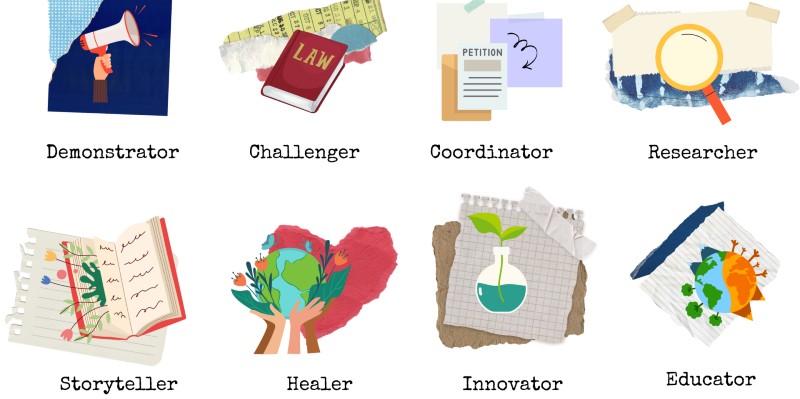
Tasked with considering how we might explore this within the context of our research, I sketched a rough series of typologies of child and youth-led climate action, inspired by conversations with our Advisors, previous experiences working with children and young people in the global climate justice movement, research case studies, and stories spotlit in the media over the years. These typologies were not meant to be definitive but rather a snapshot of the diverse actions taken by children and youth to prompt further reflection and discussion.
Inspired by magazine quizzes I poured over as a child (this was the pre-Buzzfeed quiz era!) to determine which kind of superhero or popstar or animal I would be, the activity is structured around a series of illustrated cards, each capturing a different ‘type’ of climate action. When presented to the Advisors, the typologies sparked much discussion about their roles in the climate movement. With their feedback, we tweaked the activity so it could be used within our participatory research workshops with children in Nepal, Canada, Argentina and Ireland.
Here is an overview of each of the types, together with examples of what this looks like in practice for our Young Advisors3.
Demonstrator
Joins in with protests and strikes to call for change.
In August 2018, a movement of global child and youth-led climate strikes rippled across the world, inspired by Greta Thunberg, a young Swedish activist who sat outside of the Swedish parliament for three weeks to protest the lack of climate action being taken by governments. Through press coverage and viral social media posts, her action quickly sparked what became the FridaysForFuture climate movement, galvanising 14 million activists across 7,500 cities. Akshita, from Ireland, got involved in the FridaysForFuture group in Cork, Ireland when she was 15 years old, and later took up a leadership role – coordinating the strike in September 2024.
When the COVID-19 pandemic took hold in 2020 and regulations were introduced to limit the spread of the virus including school closures and limits of public gatherings, children and young people took to ‘digitalising’ their strikes through social media. Children and young people understood the need to find new strategies that would protect others’ health but enable them to continue to draw attention to the climate crisis and ensure climate policy would not become sidelined.
With strong messaging on justice and intergenerational solidarity, children and young people’s coordination of, and involvement in, climate demonstrations has also been connected to engagement in wider social justice demonstrations such as that of the Black Lives Matter protests during the pandemic, and demonstrations held in response to genocides in Gaza and Sudan. As one of our Advisors powerfully articulated in this blog, children and young people recognise and often amplify the links between the climate, racial justice and peace movements, and the impacts of conflict, and climate, on children and future generations.
Challenger
Uses law and governance to challenge climate inaction, such as through the courts.
As a core element of our research explores, children and youth are also continuing to show significant leadership in seeking climate justice through the courts. A growing number of litigation cases have involved children and young people, eighty of which have been analysed and documented in our Youth Climate Justice Case Law Database, led by PhD Researcher and child rights lawyer, Liesl Muller. Examples have included civil court cases as well as national and international proceedings, such as the Agostinho v Portugal case in which six children and young people aged 8-25 from Portugal took a petition to the European Court of Human Rights (ECHR) against 33 countries, arguing that these countries were failing to meet their human rights obligations by not taking enough climate action. Whilst the case was deemed inadmissible due to the litigants having not exhausted all possible legal avenues in Portugal, it drew significant attention to how children’s rights are impacted by the climate crisis.
It is unusual for children to be involved in litigation on social justice issues, as Liesl and Aoife discuss in their recent paper tracking the impacts of child- and youth-led climate litigation. They also highlight that the very fact children are being heard as litigants suggests a growing recognition of children’s right to be heard (Article 12). However, as our research is also examining through interviews and focus groups, children and young people face challenges through accessing justice through the courts. As Emilia has written in her blog about being part of a climate lawsuit in Peru, a key challenge for children is being taken seriously. In her experience, some adults undermined their case as merely a ‘school project’, with others deeming it to have been an adult-led ‘manipulation’ of children’s participation.
A Challenger can also refer to children involved in influencing and shaping policy and governance, such as those engaged in consultations, workshops, children’s parliaments and councils, and global negotiations. In his role in the national children’s parliament in Morrocco, Omar has shared how being a youth parliamentarian has enabled him to propose environmental initiatives and defend climate justice through democratic decision-making processes. We have also learned much from Omar about the opportunities and challenges children and youth face when taking their local activism to the global level, through his experiences virtually participating in the UNFCCC’s COP – reflections that our recently published research on children and youth’s experiences at COP also points to.
Coordinator
Brings people together to take action, such as organising petitions, support groups.
In both demonstrating and taking to the courts, children and youth are coordinating with others to effect change. However, the ‘Coordinator’ role also extends to those driving change through mobilising others in school groups and community initiatives, recognising the power of numbers, but also of relationships and solidarity with others when advocating for change.
“I see myself as a Challenger, Researcher, Storyteller, and Coordinator. As a Challenger, I’ve taken legal action against the Peruvian Government through a youth-led climate lawsuit. As a Researcher, I’m constantly learning, driven by curiosity, and committed to understanding environmental justice, especially through Indigenous perspectives. I’m a Storyteller when it comes to sharing knowledge, like how I frame the lawsuit or write about the nature rights movement. I take on the Coordinator role when organizing meetings and interviews with my fellow plaintiffs from the climate lawsuit.” Emilia
Many members of our Young Advisory Team described take on a coordinating role in their climate action. Thubelihle, in South Africa, also plays a leadership role in her school environmental club, bringing people together to educate others about the climate crisis and environmentally-friendly lifestyle choices, as well as organising tree-planting days to inspire others to get involved. Agastya, from India, coordinates programmes in his school focused on promoting waste management and emphasising sustainable practices in the school environment. We were all delighted to hear about his recent news that he and his peers had influenced his school to become the first in India to introduce electric buses.
Innovator
Finds technical, scientific and creative solutions to climate issues.
As well as advocating for justice, children and youth are playing a key role in identifying innovative, practical solutions to challenges posed by environmental degradation and the climate crisis. Children and youth are using creativity, curiosity and technical skills to address key challenges related to justice, energy, pollution, waste reduction, and nature restoration.
Growing up in India, a country experiencing many different harmful environment and climate-related impacts, such as extreme heat, pollution, flooding, and food insecurity, Agastya is particularly interested in researching and implementing solutions to climate issues. As well as his efforts in school, Agastya is part of a social enterprise, dedicated to promoting solar rooftops, pumps and stoves for cooking. His role is raising awareness of the benefits of switching to solar, equipping people with the knowledge of this important solution.
Storyteller
Tells other about the climate crisis and advocates for change, communicating in different ways that inspire action online and offline.
Children’s climate action spans across highlighting the real lived impacts of the climate crisis, and the urgent need for both mitigation and adaptation action in different contexts across the world. Through analogue and digital platforms, children are telling their own personal stories, and those of their communities, highlighting the day-to-say struggles children face, as well as documenting the radical changes to their wider communities over years, decades, through the knowledge of their elders. Knowing the power of stories to change hearts and minds, children are finding unique, creative approaches to engage both their peers and wider audiences in the climate movement.
Sneha, from Canada, uses her love of art to tell stories about the climate crisis and particularly the effect it is having on children’s rights to education. Om, from Nepal, uses film to document and tell stories about what’s happening to others. He continues to collaborate with non-governmental organisations, clubs and community groups to raise awareness and educate others.
Educator
Teaches others what they can do about the climate crisis, showing them what they can do to help.
Children and young people recognise the need for strengthened climate education for all generations, with many taking the matter into their own hands and using their skills and knowledge to inform others about the causes, impact and solutions of the climate and environmental crises. They are taking steps to educate their peers and elders alike, weaving together intergenerational perspectives, and making technical, scientific information accessible to all.
Through digital platforms and social media, children and youth are finding creative ways to share their learnings. Alana, from Kenya, is one of our youngest advisors who started a podcast when she was 10 years old – Climate Gumzo with Alana – to inform other children (and adults) about the climate crisis. As she explains in this blog, she was inspired to start this podcast after participating in the UNFCCC’s COP28 in the United Arab Emirates (UAE in 2023), where she found herself ‘surrounded by walls of jargon and technical buzzwords that made climate solutions feel distant and inaccessible’. She interviews a series of different climate experts and advocates activists to help break complex terminology and concepts for younger audiences.
Healer
Supports the conservation and protection of nature and tries their best to live sustainably.
As Emily, PhD researcher on the YCJ project is exploring, many children and youth characterise their environmental action as being linked to a connection with, and care for, non-human nature and their physical surroundings. In recognising their own rights to grow up in a clean, healthy and sustainable environment, there is a strong awareness that this is deeply linked to the protection and realisation of the rights of nature. There are many inspiring examples of children and youth leading conservation efforts to clean, restore and protect nature across the world, and dedicating their time to implementing nature-based solutions in their local communities that can support with long-term carbon capture, regeneration of natural resources, and sustainable infrastructure.
In conjunction with her podcast, Alana is very active in tree-planting drives – planting over 20,000 trees to date! Moriah, our youngest advisor from Trinidad and Tobago, similarly gets involved in community action through her involvement in Green Enviro TT, a local NGO that promotes environmental stewardship. She is also involved in her school's Environmental Club, where children come together to learn from each other about the different ways to reduce their carbon footprint.
Healing can also relate to the actions children are taking to care and show up for others in times of crisis. Whilst Aitzaz’s climate action encompasses many aspects, his has shared his experiences of volunteering as part of relief efforts in his local community in Balochistan, Pakistan in the aftermath of devastating floods in 2022. As he describes in his blog, he chose to get involved in a local organisation who were providing supplies, food and water to those who had lost their homes, schools and livelihoods.
Researcher
Investigates what’s happening and helps others to make sense of the issues.
Children and youth are also making significant contributions to our knowledge and understanding of the climate crisis and its impacts, through research. Many children are engaged in research – either self-initiated or through participation in action research projects, highlighting different findings related to the environmental crisis from social, scientific, educational and legal perspectives.
Aitzaz has since gone on to research and raise awareness of the challenges faced by those affected by floods in Pakistan – particularly the risks faced by women and girls.
“I challenge climate inaction by researching how floods hurt girls’ education in Balochistan. As a researcher, I study issues like my grant-winning project on flood-affected schools. As a storyteller, I write essays and stories to show how climate impacts kids and get others to act.” Aitzaz
Charmaine has centred much of her climate action around researching and amplifying the experiences, and unfair treatment, of Sabah maritime indigenous peoples. She uses her research findings to create educational content for Save Rivers about the importance of Borneo’s indigenous communities for forests and rivers, and she has also co-created a book ‘The Sea is Indigenous Land Too’ about these issues and written a paper about the Pan-Borneo Highway impact on indigenous, communities of Sabah.
Community, solidarity and collective action
As these typologies signify, children and youth are deeply involved in many different avenues of climate action and demonstrating leadership in diverse ways. What is clear from our Advisors’ experiences is that their climate action is not often restricted to one type, and their sense of leadership is often experienced in relation with others:
“All the types connect with each other. It’s very hard to choose one, because once you do something, it automatically connects to another [type of climate action]!” Om
Whilst I have highlighted the remarkable climate actions our Advisors are involved in throughout this blog; their actions are far from individual in their nature. What is also clear is how deeply linked children and youth’s climate action is to being part of community, connecting with others, developing friendships with likeminded individuals, and showing solidarity with others experiencing injustices.
Similar themes have emerged through our research into children and young people's experiences participating in the UNFCCC Conference of the Parties (COP) led by Dr Florencia La Paz, and the research workshops with indigenous children in Nepal led by Dr Nabin Maharjan, which showed that children and young people recognise leadership as relational, intergenerational, collaborative and cultivating a shared vision.
Whilst there can be a tendency to single out and glorify individual children and youth’s action, we acknowledge and celebrate children and youth’s collective action, and the great efforts children and youth are taking to challenge and share power, inspire and educate others, mobilise and advocate together. Children and youth, through their climate action, are demonstrating a different meaning of leadership today – something that should prompt all of us to be asking ourselves: ‘What kind of climate leader are you?’
Katie Reid was part of the Youth Climate Justice project team, from January 2024 – January 2026, advising on children and youth participation. She continues to work in children’s rights, participation and climate justice in her role with the Child Rights International Network (CRIN).
If you would like to use these illustrated cards to prompt discussion with children and young people (or adults), we have the following English-language versions which can be easily printed or projected digitally:
- What kind of climate leader? A6 Cards - What Kind of Climate Leader Are You?
- What kind of climate leader? A4 PDF - What Kind of Climate Leader Are You? Note: these can also be used as a PowerPoint presentation.
-------------------
1 We documented our approach to making the final selection – which was far from an easy task – in a previous blog, to be transparent about our decision to all those who applied, but also to other researchers and practitioners interested in co-design with children and youth.
2 Our keystone journal article explaining this theory was published in September 2024, and you can read it here. To access a summary of this article, click here.
3 All quotes are taken from the Young Advisory Team’s Zine.