Education As a Space to Challenge Neoliberal Fascisms Or Pedagogical Praxis as a site of struggle against Neoliberal fascisms

If, as Henry Giroux warns, universities are becoming market-driven systems that foster control, exclusion, and racism, how can we resist and reimagine them as spaces for equitable learning, creativity and social responsibility?
28 November 2025 | 12:00 – 18:00 | Shtepps, University College Cork
This SATLE-funded event, organised in collaboration with ISS21 | Research for Civil Society, Environment & Social Action (REACT) and UCC Students’ Union, brought together students and educators to reflect critically on teaching, learning, and knowledge production in contemporary higher education, to discuss colonial legacies, racism, inequalities, hierarchies and market-driven curricula and to imagine, and act together for change.
Organised by Michelle Bergin, Titaś Biswas, Catherine Forde, Amina Baig, Cornelia Hauch Skovmand, Sara Lovett, and Mohammad Naeem on behalf of UCCSU this gathering responded to concerns articulated by President Michael D. Higgins, who described the trajectory of Irish higher education as “a conforming bending of the knee to an insufficiently contested neoutilitarian mediocrity.”
Specifically, this cross-disciplinary event considered two themes
- Current practices and Complicities; Are university systems and the ways we teach and learn reinforcing neoliberal fascisms
- Imagining Otherways | Transgressions | Resistances
Rooted in critical, decolonial and feminist thinking, this gathering invited us to reimagine education as a site of resistance and transformation, using an innovative [un]conference format and prioritising participatory and creative engagement.
Key Contributions
The event featured two keynote contributions.
Dr Diretnan Dikwal-Bot, Assistant Professor in Digital Media Studies & Politics and Ad Astra Fellow, University College Dublin
Dr Dikwal-Bol’s keynote, Teaching Against the Machine: Reclaiming the University from Neoliberal Fascisms, traced the rise of technosolutionism, AI-driven governance, metricisation, and the “disimagination machine” within universities and called for a renewed commitment to re-politicising knowledge and reclaiming higher education as an equitable democratic and critical space.
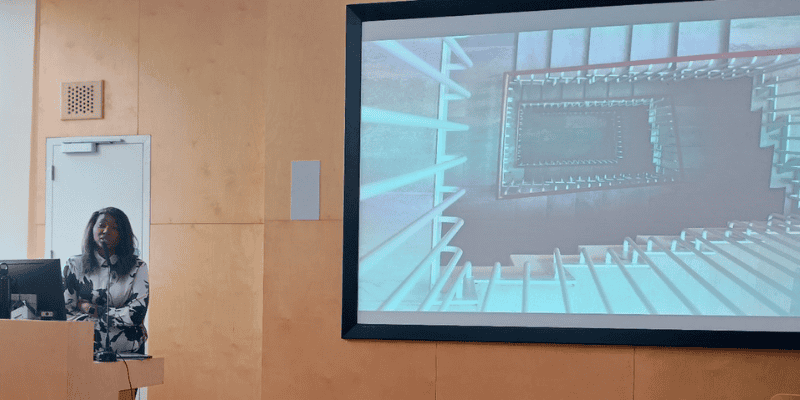
Dr Diretnan Dikwal-Bot
Professor Jennie Stephens, Professor of Climate Justice, Maynooth University
In her keynote, Reimagining Climate Justice Universities: Exnovation and Unlearning for Transformative Community-Focused Futures, Professor Stephens offered a feminist perspective on transforming universities. She emphasised the need for collective action inviting participants to engage with the Climate Justice Universities Union as part of a broader movement for change.
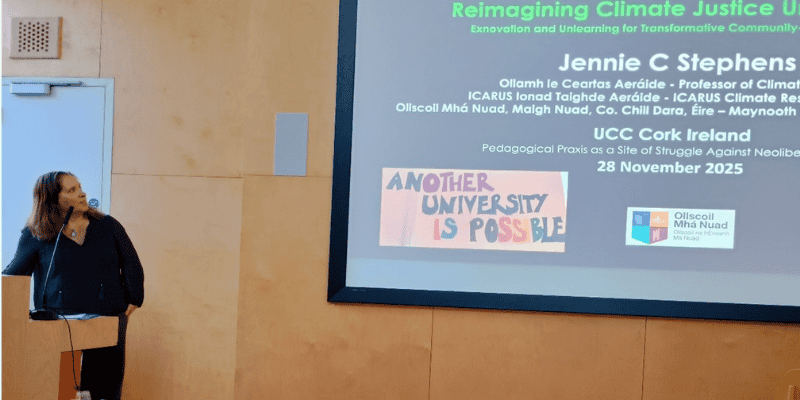
Professor Jennie Stephens
Participants contributed through:
- Open dialogue sessions, sharing reflections through discussion, provocations, poetry, and storytelling.
- Theatre of the Oppressed methods, inviting participants to imagine and rehearse transformative change in the University.
- Presentations and examples of relational practice from Dr Lydia Cumiskey (Blueprint Project, MaREI) and Wise Water Academy highlighting community-engaged research approaches.
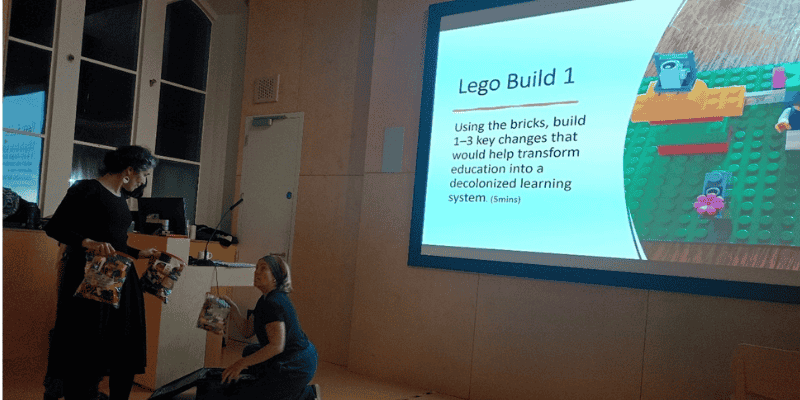
- A co-creation workshop led by Sinead Moynihan, where participants collectively identified actions for transformative education.
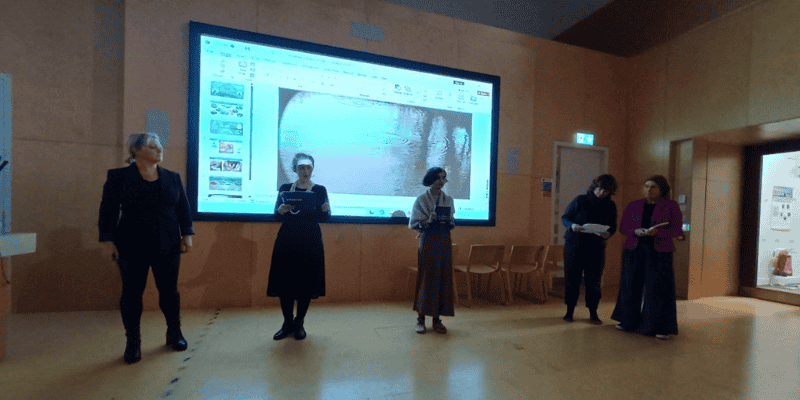
The event concluded with reflections from Professor Maggie O’Neill, Director of ISS21 and Collective Social Futures. Maggie emphasised the importance of creating spaces within universities where dialogue, critique, and collective imagination can inform intra- and inter-institutional change.
Key Learning
Across the day, several shared insights emerged:
- Transformative change requires interrogating existing teaching & learning practices in relation to colonial legacies, neoliberal hierarchies, market-driven curricula, technocratic solutions that restrict equitable possibilities for education.
- Students, researchers and educators must work together to challenge hierarchical dynamics and reclaim universities as democratic, equitable and socially responsible institutions.
- To unlearn dominant practices, it is necessary to engage with decolonial and feminist perspectives , rhizomatic thought and plural forms of knowledge and expression using dialogical, reflexive, and creative methods including storytelling, theatre, and collective reflection.
- Building solidarity networks across institutions and disciplines is essential for sustaining resistance and co-creating critical pedagogical praxis opportunities that are ethical, embodied, and inclusive and imagining alternative present and futures.
Follow-up gatherings after the event highlighted one crucial question:
Who was not in the room?
Participants emphasised the need to broaden engagement across the university and beyond, inviting those who are often absent from critical discussions into ongoing dialogues as reimagining the university as a space of justice and creativity requires collective, sustained action.
Some Shared Resources from the (un)conference
Collective Social Futures Institute
Contact us
- collectivesocialfutures@ucc.ie
- Professor Maggie O'Neill, Director of Collective Social Futures Institute