
Blog
Africa’s Children vs. the Climate Crisis: The African Committee Weighs In
African children have a rare opportunity to shape how the law responds to the climate crisis. As the African Court considers a landmark advisory opinion, a key question arises: what do States owe children—and how can young people make their voices heard in the process?
This blog post was written by PhD researcher Liesl Muller.
African children have a rare opportunity right now: to help shape how international law responds to the climate crisis. Young climate advocates and their allies are no doubt aware that the African Court on Human and Peoples’ Rights is currently considering its very own Advisory Opinion on the obligations of African States with respect to the climate crisis. It is the African version of the climate advisory opinions from the International Court of Justice (ICJ), Inter-American Court on Human Rights (IACtHR), and the International Tribunal on the Law of the Sea (ITLOS) that came before it and left an unmistakable mark on international and domestic law and activism globally. It’s an opportunity for African Children to make their mark on international law and practice by participating in the process. What the Court says could shape climate laws, court cases, and government policies across Africa and influence legal developments around the world for years to come.
The big question that the African Court is being asked to answer is:
"Under African law, what are governments required to do to address the climate crisis and protect children from climate change?”
Who has the answer?
The Court has invited African governments to submit their views. It has also welcomed input from independent experts—known as Amici Curiae (“friends of the court”)—including scientists, lawyers, affected communities, and children themselves, who are experts in their own lived experience of the climate crisis.
The Court also asked the African Committee of Experts on the Rights of the Child (ACERWC) to provide its views. This body interprets the African Charter on children’s rights and advises governments across the continent. Its written submission—called “observations”—is likely to carry significant weight in the Court’s final decision.
So, what do the African Committee’s observations say?
Here are some exciting key takeaways from the Committee’s 21-page document:
- The climate crisis is a children’s rights crisis
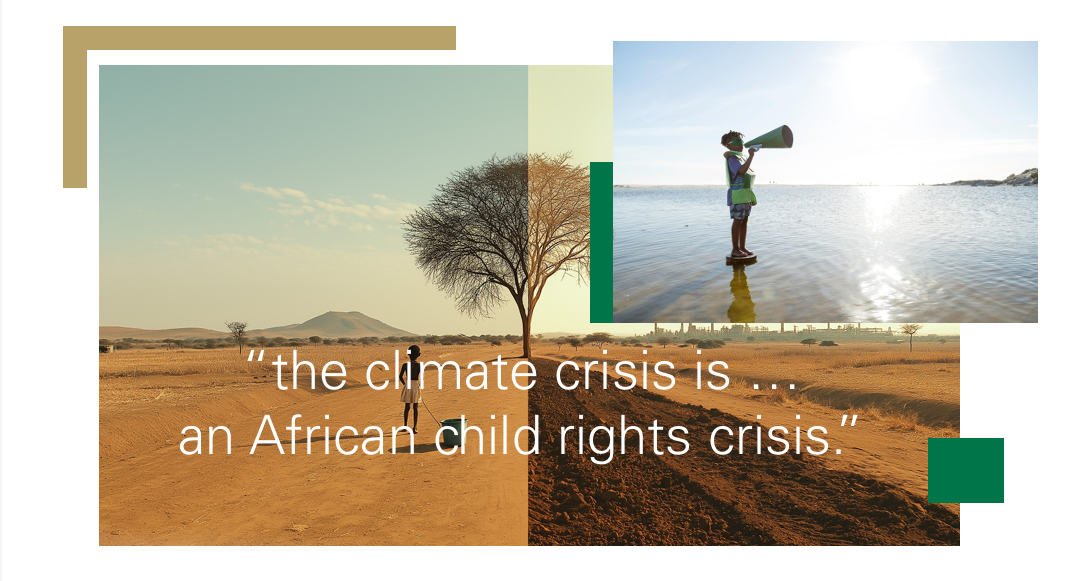
- The climate crisis is, fundamentally, an African child crisis. The Court must therefore adopt a child-rights-centred approach grounded in the African context.
- A sustainable climate is a prerequisite for the enjoyment of other children’s rights.
- Children have the right to a clean, healthy, and sustainable environment, including a sustainable climate—and this right is immediately enforceable.
- Children have the right to a life with dignity, not merely a right to survival.
- States must take into account children’s right to play in safe and green environments in public planning.
- Children as rights-holders, leaders, and contributors
- Children are not only victims of the climate crisis—they are also leaders, with the right to participate, including access to information, expression, and justice.
- Children have both the right and the responsibility to contribute to their communities, including environmental protection, as part of their right to dignity.
- Strong and specific obligations on States
- States have a special and positive duty to realise children’s rights—it is not enough to simply “do no harm”.
- The best interests of the child must be a primary consideration in all environmental decisions. This includes conducting Child Rights Impact Assessments (CRIAs) and clearly explaining how children’s interests were considered.
- States must ensure that children and future generations do not bear a disproportionate share of climate harms and responsibilities.
- Children must have access to effective, child-centred remedies when their climate rights are violated.
- The Court must interpret these obligations in light of the African Charter on the Rights and Welfare of the Child.
So what does all of this mean for children and young people across Africa?
Because the ACERWC (the children's rights experts) has already given their "testimony" to the Court, children do not need to prove that climate change is harmful —the experts have already done that. Children just need to show the Court how it is affecting their lives and dreams. But how do you speak to the Court?
Officially, only those children who are “Amici” or friends of the court can make submissions to the court, and the deadline for applications has already passed. But there are more ways to participate. You could:
- Find an Amici which shares your interests and ask how you can contribute.
- Write a letter to the Court asking it to make an exception for you and to make you a friend of the court anyway!
- Write a letter to the Court with some friends asking them to design a child-friendly procedure for children to send their testimony to the court.
- Write to the court and ask it to hold oral hearings for children.
- Raise awareness about the court process and get other children involved.
The young people involved in the ICJ Advisory Opinion had many creative ideas to get their opinions to the court. They demonstrated outside the ICJ on the day of the hearings and they told their own stories through videos featured on the Witness Stand. They also created resources, like handbooks, to explain to adults involved what children want.
It is high time for Africans to be at the centre. Africa is vastly underrepresented in international climate literature, science, media and law, but African people, especially children, are some of the most seriously impacted globally. At the same time, Africa has unique contributions to make to the climate debate. We hope that the African Committee’s observations will inspire you to participate.
-
Here are some links to resources you could use:
At the Youth Climate Justice project, we investigate the important work that child and youth climate advocates are doing in the climate crisis. That includes their climate litigation, which we say is changing how courts and states interpret the law.
You can use our Case Law Database, which also has child-friendly summaries of cases. Our Youth page has some general resources for young people, including on climate justice litigation.
Join an African youth-led climate justice organisation, like the African Climate Alliance or the WYCJ Africa Front.
*What is an Advisory Opinion?
An Advisory Opinion is a legal clarification or "expert guidance" issued by a court—like the African Court—that explains how international law should be applied to a specific issue (such as the climate crisis) without deciding a specific dispute between two parties. You can think of an Advisory Opinion as asking a Referee to clarify the rules of a game before a big foul happens, so every player knows exactly how to behave to keep the game fair.