
Blog
Croatia - Bosnia and Herzegovina border – Halfway there - Vladimir Ivanović*
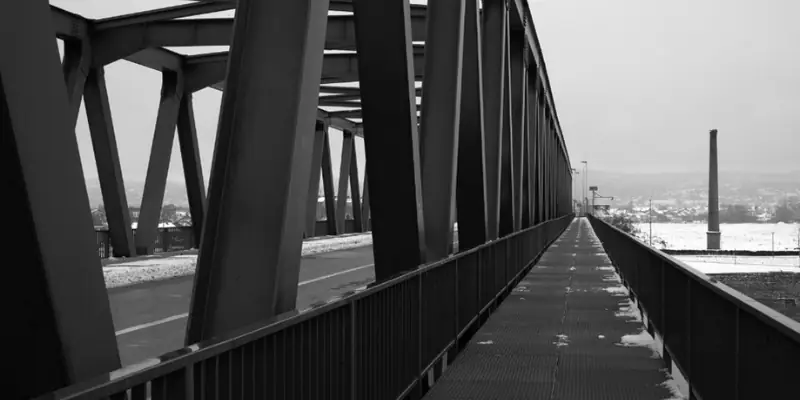
The approach of walking as a biographical method of interviewing helped our research participants open up and provide deep spatial data regarding their biographies in the borderlands. This approach allowed a somewhat “paradoxical” freedom of movement in border areas that are usually spaces of limited mobility.
Rich experiences garnered from such an approach proved to be fruitful and confirmatory of the theoretical consideration of the Croatia/BiH border area being one of so called “double periphery” (Majstorović, 2021; Leutloff-Grandits, 2023). This double periphery is seen firstly in accounts from research participants on both sides of the borders that speak to long history, or even tradition, of emigration towards their countries urban centres and to, mostly, western European countries. Secondly, the participants highlighted the feeling of being left behind and ignored by the centre of their respective countries. In both cases, the relationship remained similar – that of the periphery providing workforce and feeding “human” resources to the economic centres, both in Croatia and Bosnia and Herzegovina, as well as in EU.
And then there is this tradition... of emigration... It has existed for a long time. And not only on this side, the Bosnian side, but also on the other side, the Croatian side. Marko (Bihać, Bosnia and Herzegovina)
Besides the broad considerations and theoretical and empirical implications of the preliminary findings from the research interviews, a key theme that emerged during the walks and interviews was the war** (Homeland War in Croatia, War in Bosnia in BiH). War, for the participants and all the destruction it brings with it seemed to manifest as a breaking point in time, space, and in border social life. This severance was heavily implied and explicitly stated as after the war, people had nowhere to return. Schoolmates, friends, colleagues and social relationships were severed, basically overnight, and have hardly recovered.
Then the war came and then no, nothing, no one even argued or anything, they simply moved away, because in that whirlwind of war they scattered around the country, around Europe, I would say around the world. […] So here with us it was a free choice, and with them it was a necessity, a need. They had nowhere to go back to. Franka (Slavonski Brod, Croatia)
Another crucial theme of the fieldwork is the migrant movements on the commonly known Balkan route. Significant movement of migrants, especially in the Bihać region, ever since Croatia accessed the EU (2013), brought about major change for the local population and in the border policies of both Croatia and Bosnia and Herzegovina. Regarding this, the common experience of research participants was that of growing control and surveillance of the spaces and their personal lives. This was mainly observed in increased police presence, drones, thermal cameras and other technical solutions for control which expanded the border control area further from the border checkpoints themselves. From the perspective of locals, the experience of this migrant induced change in the border regimes was often negatively perceived from the Bosnian side and the sentiments towards migrants themselves was rooted in something best described as empathy with commonality. The experienced war trauma and displacement in Bosnia and Herzegovina seemed to, at least in some sense, soften the locals towards the migrants cause and despite themselves feeling uneasy and sometimes unsafe or insecure, due to large numbers of migrants living in their settlements, they still exhibited understanding towards them. On the other hand, Croatian research participants are highlighting the securitization of the border in a more positive light as they felt that the increased police presence was a positive thing as they felt safer from the perceived dangers of migrants. Following this line, the idea of Croatia’s border being the wall of EU is highlighted by research participants, but also in the mainstream media, public and political discourse. This, however, is not a new term and positionality of Croatia in the broader European context. During the 16th century at the height of Ottoman Empire, a term used then was that Croatian border, one towards modern day Bosnia and Herzegovina, served a role as the outer wall of Christianity. This parallel really strengthens the notion of periphery and being at the edge of EU, defending the interests of those, geographically, “behind” Croatia.
However, the stories of migrants themselves, while not yet directly experienced in our fieldwork to date, were present in the biographies of research participants on both sides of the border and in the physical environment of the borderlands. For example, in the photograph below (Željava airport), the physical border we encountered was near Željava airport, a former military airport, hidden in the mountains of the Bihać region at the border. The first set of concrete bricks is in Bosnia and Herzegovina, the second set in the middle distance is in Croatia. The hills surrounding this unofficial border crossing are full of thermal cameras, drones and police presence. Despite the physical barriers, or walls, being there in form of concrete blocks the way across is wide open. However, each attempt, not just by migrants, will lead to an arrest and a return to the originating country by the local police.
.webp "Grey concrete blocks on a road border at Zeljava Airport")
Željava airport, border near Novo Selo Koreničko, Croatia, 2025. Image: Dr John Perivolaris
Traces of the stories of migrants are also visible in abandoned shelters, houses and in stranded clothing along the border line. These spaces of recuperation and preparation for an attempt to cross from Bosnia and Herzegovina to Croatia left me feeling as if I was an investigator trying to connect the dots and find out what these people were going through. Coupled with research participants’ accounts of migrant activities, police pushbacks, violence and death they faced, a complex picture started to take form within my mind’s eye. The borderlands of Croatia and Bosnia and Herzegovina are spaces of increasingly restricted movement, mobility and growing control that coexist with the immense need and actual mobility of not just migrants, but border people as well. The paradox of the borders being at the same time rigid, violent and controlling for some, while also remaining porous for others created a sense of fear and safety on the one hand, and inequalities and mobility injustice (Sheller, 2020) on the other hand.
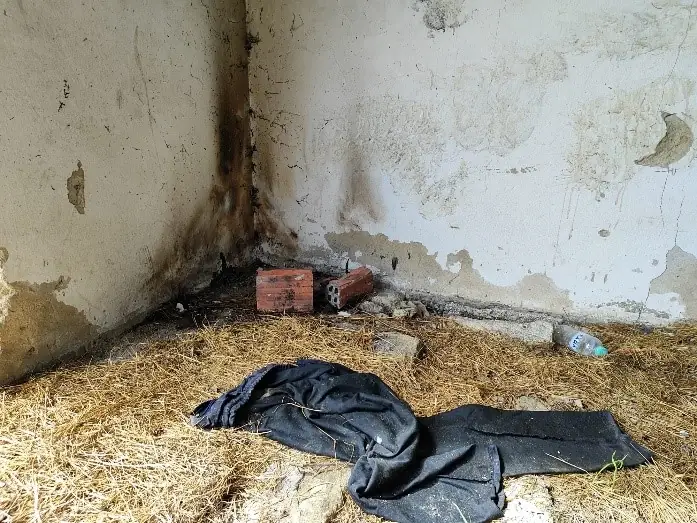
Interior of the currently abandoned temporary shelter near the border in Bihać region, Bosnia and Herzegovina, 2025. Image: Vladimir Ivanović
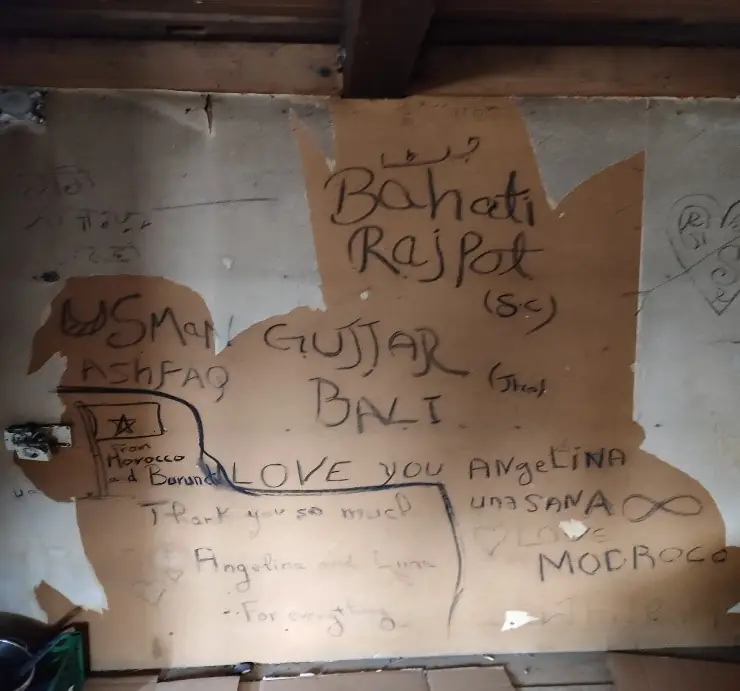
Memories in time and place of transit in an abandoned house attic near the border in Bihać region, Bosnia and Herzegovina, 2025. Image: Vladimir Ivanović
References:
- Leutloff-Grandits, C. (2023). The Balkans as “double transit space”: Boundary demarcations and boundary transgressions between local inhabitants and “transit migrants” in the shadow of the EU border regime. Journal of Borderlands Studies, 38(2), 191-209. https://doi.org/10.1080/08865655.2022.2164043
- Majstorović, D. (2021). Discourse and affect in postsocialist Bosnia and Herzegovina . Springer. https://doi.org/10.1007/978-3-030-80245-5
- Sheller, M. (2020). Mobility justice: The politics of movement in an age of extremes. Penguin Random House.
*Vladimir Ivanović is a postdoctoral researcher conducting research for the EuroBorderWalks project on the Croatian- B-H border, alongside Krešimir Žažar and artist John Perivolaris.
**The “war“ mentioned by research participants refers to the period of 1990s which encompasses the Homeland War, which is Croatian term for the war of independence after the fall of Yugoslavia that was dominantly between Croatian and Serbian army, and the War in Bosnia which saw the three ethno-religious factions wage war (Bosnian Muslims, orthodox Bosnian Serbs and catholic Bosniak Croats).