In This Section
- Home
- About the EDI Office
- News & Events
- News Archive
- Events Archive
- Newsletters
- EDIB Calendar
- Publications
- EDI Training Hub
- UCC Equality, Diversity and Inclusion Framework and Action Plan 2025-2028
- Governance and Oversight Committees
- Public Sector Duty
- Age-Friendly UCC
- Athena Swan
- Race Equality Action Plan
- LGBT+ Action Plan
- Accenture's Women on Walls
- Speak Out
- Gender Identity and Expression
- Funded Projects
- Staff Networks
- ESVH Hub
- University of Sanctuary
- EDI Data
Honora ‘Nano’ Nagle (1718-1784), Educator, Defender of the Poor and Founder of the Presentation Sisters Religious Order
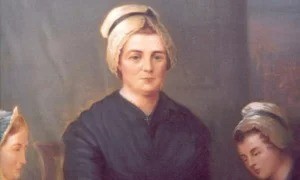
When she arrived in the world in 1718, not much would have been expected of Honora Nagle. She may have born into wealth and privilege but as a woman, opportunities were limited. However, Nano defied not only societal expectations but also ruthless political and legal forces to become a pioneering force in the field of education, championing social justice and equality, and bequeathing an extraordinary legacy to Ireland and the world.
She grew up in Ballygriffin, Co Cork, at a dark and dangerous time in Irish history, when poverty and destitution were rife. The country was in the grip of the Penal Laws, which denied Catholics education, ownership of property, and the right to worship. When she was around ten years old, she was smuggled out of the country to be educated in France with her sister Ann, a journey that was in itself a risky undertaking, and an early exercise in courage.
She spent many years in France, and after her schooling was completed she enjoyed a life mixing with high society in Paris. However, early one morning on her way home from a ball, she witnessed paupers gathering at a church for mass and the contrast between their circumstances and hers pricked her conscience. When she returned to Ireland after the death of her father in 1746, she and her sister went to live with their mother in Dublin, where she could not escape the reality of the poverty, sickness and starvation that surrounded her. She went along with Ann on visits to the poor, and on discovering that her sister had sold a roll of silk Nano had intended to use for dresses, she once again reflected on her direction in life.
After suffering a double loss with the sudden death of Ann and then her mother, Nano was unable to live on her own as an unmarried woman and returned to Ballygriffin to live with her brother David and his wife Mary. Visiting the homes of the poor in the area, she was shocked at their lack of education and religious instruction. She decided to dedicate her life to prayer, returning to Paris to enter a religious order. However, she could not wipe the suffering she had witnessed at home from her mind and after being counselled by a Jesuit priest, she decided to return home and begin her mission of helping the poor.
On her return to Cork, she lived with her brother Joseph and his wife Frances, on Cove Lane (now Douglas Street). In an act of immense bravery, as she faced imprisonment or death if her plans were discovered, she began work on her first school for girls, which was established in 1754. Housed in a mud cabin, it was an inauspicious beginning, but within ten years, aided by an inheritance from her uncle, Nano had established seven schools for boys and girls across the city. At night, her work continued as she visited the poor, traversing the dark and unsafe city by the light of the lamp she carried. She became known as ‘the Lady of the Lantern’ a striking and symbolic image emblematic of her efforts to bring hope to people living in the darkness of poverty and also the guiding light of Christ.
Nano was also a businesswoman, and a shrewd negotiator, who recognised the benefits of collaboration in achieving her goals. In this vein, in 1771 she built a convent for a number of Ursuline Sisters to help continue her work. However, her efforts were frustrated when the ecclesiastical law of enclosure meant they were unable to travel through the city. Nano became determined to set up her own order and on December 24, 1775, she and three others began the preparation for the taking of vows that would lead to the establishment of the Presentation Sisters of the Blessed Virgin Mary. Nano’s tireless efforts eventually took their toll and she died from tuberculosis on April 26, 1784 at the age of 66, having dedicated herself to the service of God through the poor.
Her mission and message continued to spread in the years that followed. While playing an invaluable role in the education of children in Cork and Munster, the Presentation Order also quickly expanded outside the country, establishing communities and networks that spanned continents. The convent schools were an empowering environment for millions of young girls and produced generations of strong and powerful women.
In the spirit of Nano’s innovative vision, the order continues to evolve and look to the future. One of the order’s notable achievements is the impressive transformation of the site of her original convent on Douglas Street into a complex housing Nano’s tomb, the Sisters Graveyard, a museum, chapel, gardens, bookshop and cafés. Nano Nagle Place has become a significant tourist attraction, drawing thousands of visitors a year. It is often described as an oasis in the city, reflecting a deeply spiritual ambience, redolent of the contemplation and prayer which sustained Nano in her work. It has also become a home for community education and social justice initiatives such as the Lantern Project, Men’s Group and Cork Migrant Centre. There is also a small community of Presentation Sisters still in residence at Nano Nagle Place, where they continue the hospitality of their founder and connect with others inspired by her work.
The significant global impact of Nano’s life and work was acknowledged on October 31, 2013, when she was declared Venerable by Pope Francis, another step on the road to canonisation. Her recognition as “a woman of faith, hope, and heroic virtue whose vision and work transformed the lives of very many” was welcomed by the Presentation Sisters. It is remarkable that more than 300 years after her birth, as they prepare to celebrate the 250th anniversary of the founding of the congregation, Nano’s influence is stronger than ever, as those that follow her continue to be a guiding light to those in need.