In This Section
- Home
- About the EDI Office
- News & Events
- News Archive
- Events Archive
- Newsletters
- EDIB Calendar
- Publications
- EDI Training Hub
- UCC Equality, Diversity and Inclusion Framework and Action Plan 2025-2028
- Governance and Oversight Committees
- Public Sector Duty
- Age-Friendly UCC
- Athena Swan
- Race Equality Action Plan
- LGBT+ Action Plan
- Accenture's Women on Walls
- Speak Out
- Gender Identity and Expression
- Funded Projects
- Staff Networks
- ESVH Hub
- University of Sanctuary
- EDI Data
Dola Twomey, Campaigner and Therapist at the Sexual Violence Centre
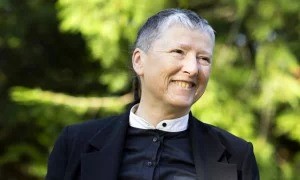
Dola Twomey was not a big fan of school but growing up on Shandon Street in the heart of Cork, where her parents had a small grocery shop, was an education in itself. It was also where she first became aware of how inequality and injustice shaped people’s lives.
“It was a very alive part of the world, you could see human life and all its vagaries. I saw there was a pecking order, and people’s life chances were totally dictated by that. But I loved it. I felt totally at home there. Which is probably why I’ve never left.”
Dola has left her mark on her native city in her work as a therapist and campaigner at the Sexual Violence Centre on Camden Quay, just a short walk from her childhood home. She attended St Vincent’s primary school, finishing her secondary education at St Angela’s school in 1978. It was a time of recession and emigration, when the outlook was bleak. Dola went on to work for the HSE for a number of years. Meeting her partner Mary Crilly was a pivotal moment in her life. “She’s one of these people that once she gets you in her clutches, you might as well surrender. She can find work to do for everybody.”
Dola came on board with projects Mary was running at the time, including a support service for women who had experienced domestic violence. Being involved in their lives, along with a curiosity and desire to understand what the women were going through spurred Dola on to train as a therapist. Favouring a different focus to what she considered the more prescriptive training on offer in Ireland, she spent many years studying psychotherapy in the Netherlands and the UK.
Her work as a therapist in the Sexual Violence Centre brings great responsibility but she also describes it as life-enhancing. “You're holding hope for somebody up to a point where they can see it for themselves. It's a huge privilege and very precious, and something that needs to be minded really well. Every client I've ever met has given me something. They've all impacted me.”
When it comes to the campaigning side of her work, Dola says the fight isn’t necessarily against the perpetrators of sexual violence but the system that enables and facilitates them. She points to the centre’s continuing work on human trafficking and says that when they were trying to raise awareness of the issue in the early 2000s, there was a denial by institutions that it was even happening. The same dynamic applies to the issues of stalking and harassment. While standalone legislation has been introduced, she says there has been no public awareness campaign, and no training for gardaí and court services. She describes these times when nothing is happening as a huge source of frustration and one of her biggest struggles. While policy and legislation play a role in achieving change, Dola hopes for an even more radical outcome; a complete transformation in how sexual violence is perceived. “We've done it before — I remember people smoking on planes, in hospitals, now we wouldn't dream of doing it. What was totally acceptable, facilitated, is no longer tolerated. Sexual violence is one form of violence on a spectrum. It’s ultimately about how we treat people and how we think of people.”
Dola has seen many positive changes in her work as a therapist and campaigner. She says institutional abuse especially has been brought out in the open, and lifting the veil of shame and stigma has had a profound effect. While previously, many people would have told no-one about their abuse, that has completely turned on its head. “Now they will have told a friend or a parent. That's a culture shift — that something that couldn't be spoken about can be spoken about. That's phenomenal. No policy has done that, no institution has done that. That is people.”
She describes herself as a “low-flying optimist” and says her faith in people continues to be renewed through the collaboration and co-operation she sees in her work. “Anything that I've managed to pull out the bag I didn’t do myself, nor would it have actually worked. You get people to throw their weight in with you, then you've started a momentum that is pretty much unstoppable. I think of the women through the years who have been incredible champions for us; the world will never know because they stood up to the plate without expecting any nod of gratitude.”