
News and events
Translating World Literatures: A Night of Voices, Languages and New Perspectives
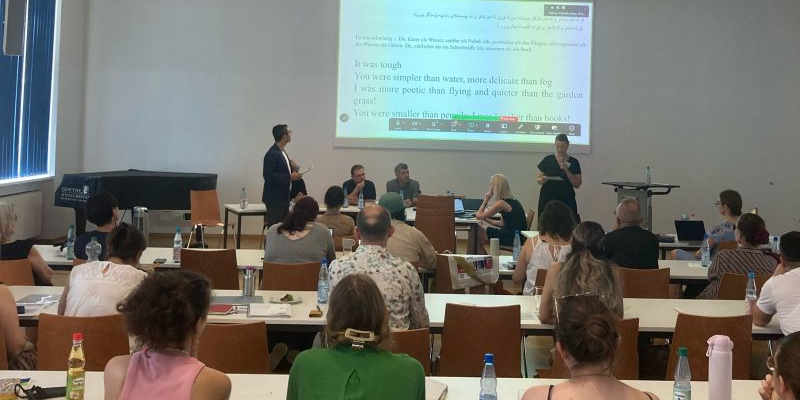
On 26 June, our COST Action MultiLiLiTrans contributed to the conference “Literarische Mehrsprachigkeit und ihre Didaktik II: Poetik – Ästhetik – Didaktik” in Frankfurt, organised by Astrid Henning-Mohr, Laura Kiefer, Martina Kofer and Ute Filsinger. As part of the conference programme, we hosted an evening dedicated to the literary texts of Kurdish writer Bachtyar Ali.
Under the title “Translating World Literatures – Bachtyar Alis Werk in Übersetzung”, the multilingual event brought together Bachtyar Ali himself, his translator into German Rawezh Salim, and his translator into English Kareem Abdulrahman for a reading and a conversation on writing and translating in multilingual contexts. The evening was chaired by Myriam-Naomi Walburg, leader of Working Group 5, and Hiwa Asadpour, member of our COST Action.
It was a rare and precious opportunity to hear Bachtyar Ali’s words in their original form: read aloud in Kurdish Sorani by the author himself, accompanied by passages brought into English and German by his translators. Beyond the beauty of these multilingual voices, the evening opened a space to explore the particularities of the Kurdish language and to reflect on how concepts of world literature are challenged — and perhaps need to be expanded — by literary works that cross linguistic and cultural borders in complex and multifaceted ways.
Bachtyar Ali, who has lived in Germany for many years, made the conscious decision not to change his language of writing, but to continue creating literature in Kurdish Sorani. His work reminds us that world literature is not only shaped by writers who move between countries and languages, or by the translations that allow texts to travel across borders. Rather, it also emerges through the encounters between texts and readers.
From its very beginnings, the concept of Weltliteratur — a term famously coined by Goethe after having read Chinese literature, translated into German — has been inseparable from translation. Yet, as the discussion made clear, another perspective is equally essential: the perspective of the reader. Every reader approaches a text with their own history of reading, their own linguistic experiences, and their own constellation of memories and associations. These individual networks become part of the life of a literary work. As Bachtyar Ali, Rawezh Salim and Kareem Abdulrahman confirmed, those individual networks cannot be fully controlled by either the author or the translator — yet they are precisely what allow a text to enter the ever-changing landscape of world literature.
The evening highlighted the importance of thinking further about the question of how we perceive the world, as one of the translators emphasised during the discussion. Literature has the power to transform this perception: stories reshape our imagination, open new ways of seeing, and alter the landscapes of our inner worlds.
Or, as Bachtyar Ali offered in this poetic image:
“Texte sind Vögel. Ein Vogel kann in einem anderen Wald fliegen. Die Frage ist, wie anpassungsfähig ist der Wald, wie sauber und freundlich ist dieser Wald?“ (“Texts are like birds. A bird can fly into another forest. The question is: how adaptable is the forest? How clean, how welcoming, how friendly is it?”)
Translators are among those who help these birds find new forests. They create pathways between languages, enabling texts to travel, take root, and bring new light into different literary landscapes. They make texts “fly”. Yet translators do so not only as mediators between languages, but also as profoundly attentive readers. Translation is a particular form of reading — one characterised by hesitation, by moments of uncertainty, by erasure and rewriting - during the discussion, translation was described as “the art of failure” - and finally by constant movement back and forth between languages; a movement that was made visible and hearable during the whole evening.
An evening that continues to resonate — inviting us to listen more closely, think further, and imagine new ways of encountering the worlds and languages carried within literature.