In This Section
- Home
- Governance
- Governing Authority
- Membership of Governing Authority
- Committees of Governing Authority
- Schedule of Meetings of Governing Authority
- Reports to Staff of Governing Body Meetings
- Due Dates for Meeting Documentation
- Regulation on Conduct of Governing Authority Business
- Decisions reserved to Governing Authority
- Code of Conduct for Governing Authority Members
- University Governance
- Statutes & Regulations
- University Companies
- Governing Authority
- Legal & Information Compliance
- Enterprise Risk Management
- University Safety Policy
- Training Timetable
- Safety Statements
- Incident Reporting
- Risk Assessment
- Emergencies
- Fieldwork
- Staff Safety Representatives
- Ventilation
- Health and Safety
- About
- Training
- University Safety Policies
- Managing Health & Safety
- Safety Statements
- Risk Assessments
- Occupational Health & Ergonomics
- Fieldwork
- Staff Safety Reps
- Permit to Work
- Other Safety Contacts
- Occupational Hygiene
- Blended Working Risk Assessments
- Research Projects/Lab Adaptations
- Health & Safety Authority Inspections
- Ventilation
- Radiation, Ionising and Non-Ionising
- Health & Safety and Security
- Health & Safety for Student Activity
- Incidents & Emergencies
- Policies
- Contact Us
Conflict of Interest Form
Conflict of Interest Local Register Template
Please see the following link to the template for a Conflict of Interest local register.
Conflict of Interest Management Procedure
Context
University staff have diverse interests and contacts within the local, national and international community. These links between people engaged in UCC activity and outside bodies are often in the public interest as well as beneficial to the University and to individuals. However, some potential conflicts of interest may arise from time to time.
The conflict of interest policy assists staff in recognising and managing any potential conflicts of interest that may arise. The most important message in the policy is that University staff should always disclose an activity if they are in doubt about whether it represents a conflict of Interest.
Purpose
This procedure details
- the steps to be taken by someone declaring a potential conflict of interest;
- the steps to be taken by the COI reviewer when a potential conflict of interest has been declared.
Procedure
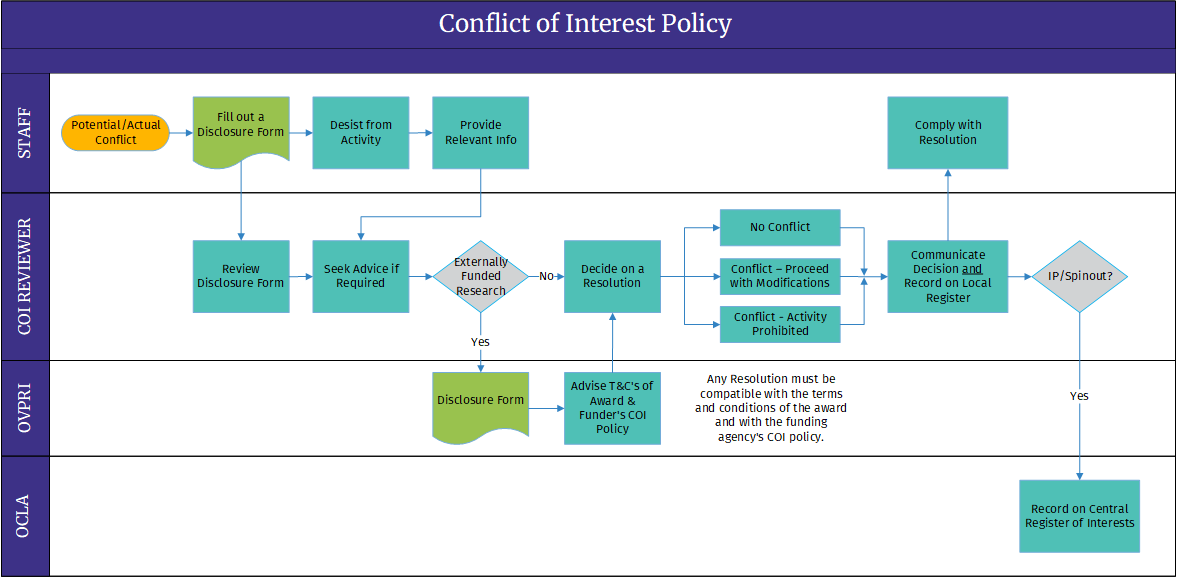
Step 1: Declare the Potential Conflict of Interest
A potential conflict of interest should be declared as soon as:
- the conflict of interest first arises;
- it is recognised that a conflict of interest might be perceived; or
- it is recognised that there is the potential for a conflict of interest.
Staff: Complete the and send it to the Conflict of Interest reviewer as per the Disclosure Channels.
The person to whom the disclosure has been made, within the framework set out at Disclosure Channels, shall become the COI Reviewer for the purpose of determining the appropriate next steps to be taken in relation to the potential conflict of interest.
The Conflict of Interest Reviewer that you have selected should be in accordance with the Disclosure Channels.
Staff: Do not take direct part in the activity relating to the potential conflict until you have talked to the COI reviewer and agreed that it is ok to do so. The COI reviewer will advise you whether you can resume taking part in the activity as soon as is possible but generally within 21 days from the date of disclosure.
Step 2: Review the Disclosure and Gather Relevant Information
COI Reviewer: Review the disclosure and, if required, request further information from the person who disclosed.
Staff: Provide any further information requested by the COI reviewer.
COI Reviewer: While the majority of potential conflicts of interest can be resolved locally, in some cases you may wish to seek advice from others in the relevant professional areas. The following table lists some possible sources of advice for the various types of conflict of interest.
| Type of Potential Conflict |
Possible Sources of Advice |
| Academic |
Head of College / Deputy President and Registrar |
| Research |
Head of College / VP for Research and Innovation |
| Spinouts/Start Ups/IP Issues: |
Head of College/Chief Financial Officer/ VP for Research and Innovation |
| Sale, Supply or Purchase of Goods and Services |
Head of College/Chief Financial Officer |
| Directorship/ Consultancy |
Head of College/ VP for Research and Innovation |
| Recruitment/ Promotion |
Chief People and Culture Officer |
COI Reviewer: Generally, potential conflicts of interest related to research can be resolved at a local level. However, if the potential conflict relates to an externally funded research project, you are required to consult with the Vice President for Research and Innovation.
COI Reviewer: Document all the information gathered on the
Step 3: Decide on How to Manage the Potential Conflict
COI Reviewer: Having reviewed all the relevant information and consulted as appropriate, decide how the potential conflict will be managed. Potential outcomes are:
- there is no conflict and no further action is required;
- permission to continue the activity with modifications;
- the staff member is to desist from partaking in activity.
COI Reviewer: Document the decision on the and the reason(s) for the outcome. If the activity is to continue, document what modifications are required.
COI Reviewer: If ongoing management is required, enter a review date and the steps to be taken during the next review. The COI Reviewer must ensure the review takes place by the review date and a further review is scheduled if required.
Step 4: Communicate the Outcome
COI Reviewer: Communicate the outcome to the member of staff and any other relevant parties.
Staff: Confirm to the COI reviewer that you agree with and intend to comply with the outcome and actions in the Conflicts Management Plan.
Staff: Implement the modifications detailed, if any, in the Conflict of Interest Management form.
Step 5: Record the Outcome
COI Reviewer: A record of the conclusion of conflict of interest reports should be held on a local register of interests and external activities. Conflicts of Interest relating to Intellectual Property and the establishment of spinout companies should be shared with OCLA after they have been through the COI reviewer via the following email address: conflictofinterest@ucc.ie
Conflict of Interest Management Procedure in relation to recruitment and promotion
Whilst the procedure for managing the Conflict of Interest is the same for Conflicts of Interest relating to recruitment and promotion, the Chair of the relevant search/selection committee and promotions boards shall be required to brief the committee/board prior to each relevant meeting as to the main provisions of the Conflict of Interest Policy.
Where decisions are being made in relation to selection and promotion, each member of the selection committee/promotions board will be asked to confirm that no Conflict of Interest exists, or if such a conflict exists it has been deemed a manageable conflict (see 5.4.3 above) and shall sign a report to this effect at the commencement of the meeting.
External assessors shall, at the time of invitation, be given details of this Policy and where possible the names and applications of the prospective candidate(s) to assist in ensuring that the impartial role of the external assessor is maintained within the appointments and promotions process. If an external assessor is invited to participate in the process at the pre-shortlisting stage when details of applications are not known and should any issue subsequently arise in terms of a candidate applying for the post which would then create a Conflict of Interest for the external assessor, then this matter should be managed in accordance with this Policy.
The outcomes of the Conflict of Interest may be as set out in the policy. The following should be noted.
Documentation/drafting: Outcome may involve the recommencement of drafting of documentation without the involvement of the person with a Conflict of Interest.
Conflict of Interest is deemed manageable: The Chairperson manages the decision-making process and the individual with the Conflict of Interest should speak last in the course of discussions on the candidates.
Conflict of Interest is deemed now manageable: Withdrawal of a member or of the Chairperson will be recorded in the minutes of the meeting.
Conflict of Interest Management Procedure Flow Chart