

Researchers' Blog
Better Together: do multi-species swards exhibit better ecosystem resilience?
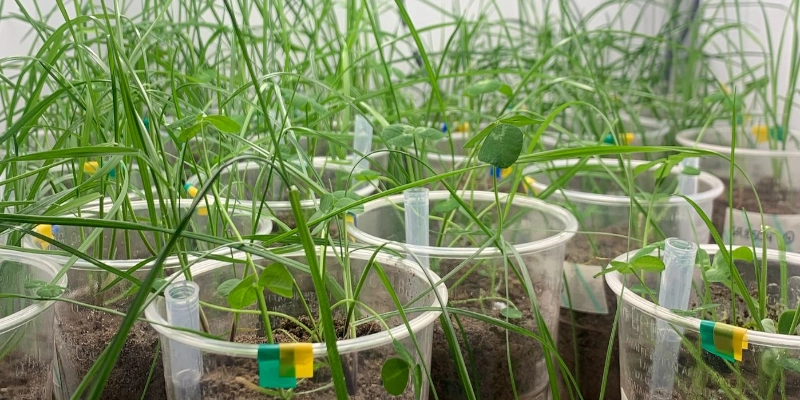
Are multispecies swards more resilient to abiotic stressors than single species paddocks? Can diversity futureproof agricultural pastures against the challanges of climate change? Grace Hurley shares insights into the potential benefits of multi-species pasture swards.
Much of the research on climate change impacts in agriculture has traditionally focused on single plant species. While this has provided valuable insights, modern methods of using multiple species in pasture crops are becoming more prevalent and need to be investigated further. Today, multi-species sward crops (where several plant species grow together) are becoming increasingly popular. As a result, it is essential that we understand how climate change affects plants when they grow in combination, rather than in isolation.
This shift in focus aims to investigate practical applications of the biodiversity insurance hypothesis, which is defined as:
“Any long-term effects of biodiversity that contribute to maintain or enhance ecosystem function in the face of environmental fluctuation”
(Yachi & Loreau, 1999)
In biodiverse plant ecosystems, such as multi-species pasture swards, species diversity can help ensure ecosystem functioning during periods of climatic stress. Differences among species in climate resilience and adaptive traits mean that, under stressful conditions, species that normally play a minor role may increase in importance. These species can effectively replace less tolerant species, becoming key drivers of productivity and stability. Consequently, the functional resilience of a plant community to environmental stress may be enhanced through high ecotype and species diversity.
Plant Resilience: Differences Between and Within Species
Resilience to environmental stressors does not only vary between species—it can also vary substantially within species. Some plant species tolerate stress better than others due to specific characteristics such as rooting depth, leaf length, leaf area, water-use efficiency, and competitive ability.
Several studies have investigated these differences. For example, Malyshev et al. (2016) exposed a variety of grasses and forbs to stressful conditions and compared variation both within a single species and between different species. Interestingly, they found that within-species variation was as large as variation between species. Their results also highlighted that plant responses to extreme climatic events are complex and trait-specific and are not simply intensified versions of responses to gradual climate change. This suggests that plant reactions to heatwaves or droughts cannot be predicted solely from studies of incremental environmental change.
How Different Crops Respond to Climate Stress
In multi-species pasture systems, grasses are often pared with other agricultural forage species. Several studies suggest that grasses may be less tolerant to climatic stress—particularly drought—than other forage crops.
For instance, when compared with tall fescue, perennial ryegrass showed poorer drought tolerance due to its weaker root system and reduced ability to retain water (Jiang & Huang, 2001). Similarly, chicory outperformed perennial ryegrass under drought and heat stress, maintaining a higher photosynthetic rate and better internal water balance (Perera et al., 2019).
Differences in drought tolerance have also been observed among grass species themselves. Andropogon gerardii (big bluestem) was found to be more drought tolerant than Sorghastrum nutans (Indian grass), highlighting how functional traits influence resilience even within similar plant groups (Hoover et al., 2014).
What This Means for Multi-species swards
Taken together, these findings support the idea that diverse multi-species systems may be better equipped to cope with climate variability. By combining species with different stress tolerances and functional traits, farmers can create cropping systems that are more resilient to drought, heat, and extreme climatic events—an outcome that directly reflects the principles of the biodiversity insurance hypothesis.
References
- Hoover, D.L., Knapp, A.K. and Smith, M.D., 2014. Resistance and resilience of a grassland ecosystem to climate extremes. Ecology, 95(9), pp.2646-2656.
- Jiang, Y. and Huang, B., 2001. Physiological responses to heat stress alone or in combination with drought: A comparison between tall fescue and perennial ryegrass. Horticultural Science, 36(4), pp.682-686.
- Malyshev, A.V., Arfin Khan, M.A., Beierkuhnlein, C., Steinbauer, M.J., Henry, H.A., Jentsch, A., Dengler, J., Willner, E. and Kreyling, J., 2016. Plant responses to climatic extremes: Within‐species variation equals among‐species variation. Global Change Biology, 22(1), pp.449-464.
- Perera, R.S., Cullen, B.R. and Eckard, R.J., 2019. Growth and physiological responses of temperate pasture species to consecutive heat and drought stresses. Plants, 8(7), p.227.
- Yachi, S. and Loreau, M., 1999. Biodiversity and ecosystem productivity in a fluctuating environment: the insurance hypothesis. Proceedings of the National Academy of Sciences, 96(4), pp.1463-1468.