News and events
How to Produce a Multilingual Podcast - 5 Questions & Answers
In this interview, COST Science Communication Coordinator Markéta Brožová (University of Jan Evangelista Purkyně) chats with Michele Vangi, COST Governance and Civil Society Vice-Coordinator (Università degli Studi Roma Tre) about producing the multilingual podcast „Oltrelinguae - Voci d’autore fra identità, diaspore e scritture“.
How to Produce a Multilingual Podcast - 5 Questions & Answers
with Michele Vangi, COST Governance and Civil Society Vice-Coordinator (Università degli Studi Roma Tre)
1) Michele, could you please tell us more about this podcast? What is it about?
Hello Markéta, thank you for having me! I'm very pleased to answer your questions and to share a little of the story behind this podcast project.
The podcast grew out of a larger project called Oltrelinguae, which I coordinated together with my colleague Laura Piccolo at the Department of Foreign Languages, Literatures and Cultures of Roma Tre University. Throughout 2026, we organized ten in-person meetings with writers from different linguistic and cultural backgrounds, all of whom shared experiences of migration, diaspora, and writing in a language other than their mother tongue. It was an exciting experience, and the podcast was born directly from it. We selected four of the writers who came to Rome because, unfortunately, it wasn't possible to include all ten.
2) Multilingualism and podcasts – they seem to be a difficult connection. How does this fit together?
This is a challenge worth taking on if we want to make European society, including its media landscape, more pluralistic. Podcasts are an extraordinary tool, and I think we are still far from exploiting their full potential. First of all, they allow us to reach a very broad online audience. At the same time, they also have an archival dimension: they create a record that remains available for the future. Without the podcast, the authors' reflections on multilingualism would have remained within the context of those live events, important as they were. The podcast allows those conversations to continue reaching new listeners over time.
3) How long did it take to produce this content? Could you briefly comment on the technical part of that?
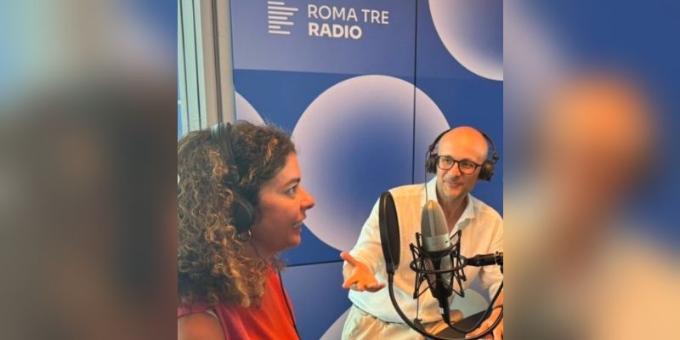
We wanted to produce the podcast with great care, paying particular attention to the multilingual backgrounds of our guests. For that reason, even though the recordings took place between April and June 2026, the post-production phase required quite a lot of work. The technical infrastructure provided by Roma Tre Radio was essential. It is a very interesting university radio station because it is highly open to educational and experimental projects, often involving students as well. At the same time, this podcast would not have reached its current quality without the support of the COST Action MultiLiLiTrans, which I would like to thank explicitly. What I particularly appreciate is that the podcast brings together two complementary dimensions: the local one represented by Oltrelinguae in Rome, and the broader European perspective represented by MultiLiLiTrans.
4) How did you deal with multilingualism when preparing and producing this podcast, as this is finally in Italian?
Well, I wouldn't actually say that the podcast is exclusively in Italian, since the interviews with Tassadit Imache and Matthias Nawrat are conducted in French and German respectively. This was a deliberate choice. Together with the editorial team at Roma Tre Radio, we decided not to dub or synchronise the interviews, but to preserve the authors' original languages and the unique timbre of their voices. The episodes are introduced in Italian, but our idea was to speak with each author in the language in which they write. In the case of Adrian Bravi and Sahra Mustafa, that language is Italian. However, if you listen to the interviews, you'll notice that both of them reflect extensively on the languages of their childhood, Spanish and Arabic. Of course, we also had to think about Italian listeners who may not speak French or German. That's why we decided to include Italian translations of the transcripts in the episode descriptions. The descriptions themselves are available in two or three languages. There is certainly room for improvement, and that's actually one of the things I like most about podcasts: they can always be expanded and updated. For example, we could add English transcripts of all the interviews in the future.
5) Moreover, what this podcast means to you personally?
I already had some experience taking part in radio programmes, but I had never conceived, produced, and hosted an entire podcast series. The experience has meant a great deal to me. On the one hand, multilingualism is a topic that is very close to my heart because of its cultural, social, and political importance in today's Europe.
On the other hand, producing a podcast has allowed me to approach literature from a completely different perspective than university teaching. In fact, the experience has already enriched my teaching considerably. It has encouraged me to experiment with new formats and to develop further projects together with students at Roma Tre Radio.
I very much hope this is only the beginning and that we will have the opportunity to repeat and expand this experience in the future.
The podcast was created as part of a project curated by Laura Piccolo and Michele Vangi (Università Roma Tre) and was supported by funding from the COST Action MultiLiLiTrans – Literary Multilingualism and Social Transformations in Superdiverse Societies. It was recorded at the studios of Roma Tre Radio.
Listen here:
https://lnkd.in/dT9gS5ge
https://lnkd.in/d7EhC_Bg