

Publications
Optimising submarine cable routes from offshore wind farms
- Authors
Kevin Walsh, Paul Holloway & Aaron Lim
- Year
- 2026
- Journal Name
- Journal of Ocean Engineering and Marine Energy
- Category
- Journal Article
- Keywords
- Submarine export cables Offshore wind energy Multi-criteria decision-making analysis Site suitability Route selection Sub-bottom profile analysis
- Full Citation
Walsh, K., Holloway, P. & Lim, A. Optimising submarine cable routes from offshore wind farms. J. Ocean Eng. Mar. Energy (2026). https://doi.org/10.1007/s40722-026-00472-7
- Link to Publication
- https://link.springer.com/article/10.1007/s40722-026-00472-7#citeas
Abstract
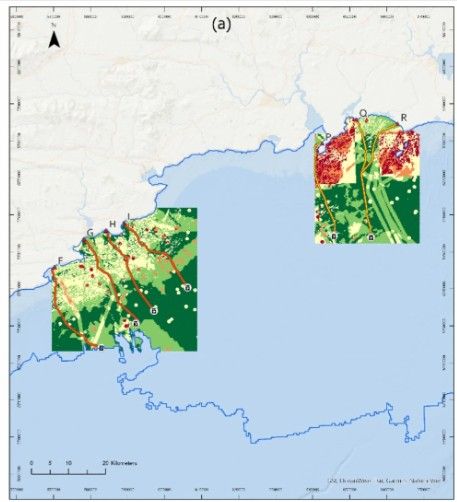
Submarine export cables (SECs) are an essential component of any offshore wind farm (OWF), serving as the primary conduit for energy transmission to the onshore grid. As floating wind technology advances, the increasing distance of OWFs from the shore results in longer and more complex SEC routes, raising costs and potential environmental impacts. This study presents a comprehensive approach to optimising SEC routes, aimed at enhancing the efficiency of site selection and ensuring the long-term reliability of OWFs. By compiling a geospatial repository of publicly available data, the study reviews and evaluates SEC route feasibility using bathymetric, geological, ecological, and human activity data. The Analytical Hierarchical Process was used to establish criteria weights for two anticipated scenarios for Ireland's South and West coasts, classifying regions into zones of suitability based on economic and environmental considerations. In areas designated for offshore wind development, potential offshore substation and cable landfall sites were identified and optimised SEC routes were generated using a Least Cost Path Algorithm. Openly available sub-bottom profile data were analysed in two key regions, providing a novel use case of repurposing publicly accessible data for the planning of offshore infrastructure. Derived sediment thickness profiles further refined cable routing away from areas with outcropping bedrock toward areas with optimal sediment thicknesses for cable burial, thereby minimising the risk to cables from external hazards. The results of the study highlight key areas for offshore wind projects, as well as providing a scalable workflow for policymakers and developers of offshore renewable energy projects.