


Publications
Flow-aligned frameworks: linking benthic currents to cold-water coral mound development using 3D photogrammetry and ADCP data
- Authors
Corie M. B. Boolukos, Laurence H. De Clippele, Paul Holloway, Larissa Macedo Cruz de Oliveira, Gerard Summers & Aaron Lim
- Year
- 2026
- Journal Name
- Coral Reefs
- Category
- Journal Article
- Keywords
- Cold-water coral NE Atlantic Photogrammetry Benthic currents Framework orientation Spatial distribution
- Full Citation
Boolukos, C.M.B., De Clippele, L.H., Holloway, P. et al. Flow-aligned frameworks: linking benthic currents to cold-water coral mound development using 3D photogrammetry and ADCP data. Coral Reefs (2026). https://doi.org/10.1007/s00338-026-02846-7
- Link to Publication
- https://link.springer.com/article/10.1007/s00338-026-02846-7?utm_source=researchgate.net&utm_medium=article#citeas
Abstract
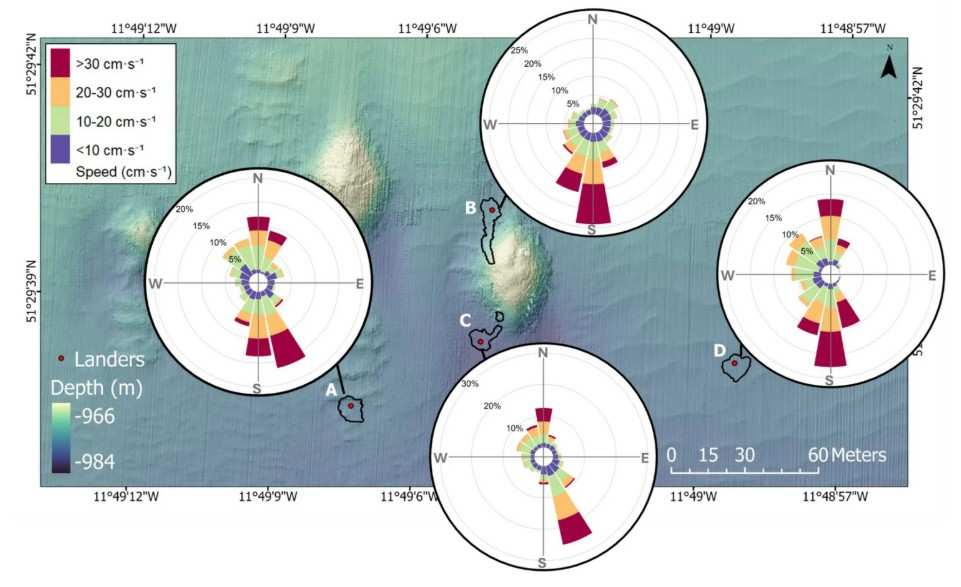
Scleractinian cold-water corals (CWC) rely on benthic currents for the delivery of food and other resources that support their growth and subsequent mound development in the deep sea. However, the CWC-current relationship remains poorly understood, as current knowledge is predominantly derived from spatially constrained ex-situ experimentation and coarse-scale modeling. Therefore, we combined long-term in situ acoustic Doppler current profile measurements with high-resolution photogrammetric data to clarify CWC-current interactions at the ‘mound-scale’ and ‘framework-scale’ across 4 sites in the Moira Mounds region (Belgica Mound Province, NE Atlantic). Study sites are characterized by prevailing north-directed regional flows and N-S oscillating tidal flows. These flows are locally modified by interactions with a well-developed CWC mound (i.e., ‘mound-scale’): north-directed currents prevail, and south-directed currents are reduced at the southern flank, while the opposite occurs along the northern flank. At the finer ‘framework-scale,’ we found that frameworks align with the prevailing flows at either flank, while CWC cover declines from the northern flank (1.32%) to the southern flank (0.05%). This decline is potentially linked to weaker, less persistent north-directed flows at the southern flank compared to the stronger south-directed flows at the northern flank. These patterns did not emerge at a site containing smaller CWC features, suggesting that their development is controlled by antecedent topography. This innovative and in situ approach demonstrates, at finer spatial scales, that the growth of smaller CWC features is primarily shaped by seafloor structure, while CWCs associated with larger features such as mounds increasingly align with local hydrodynamic processes.