Political Technologies

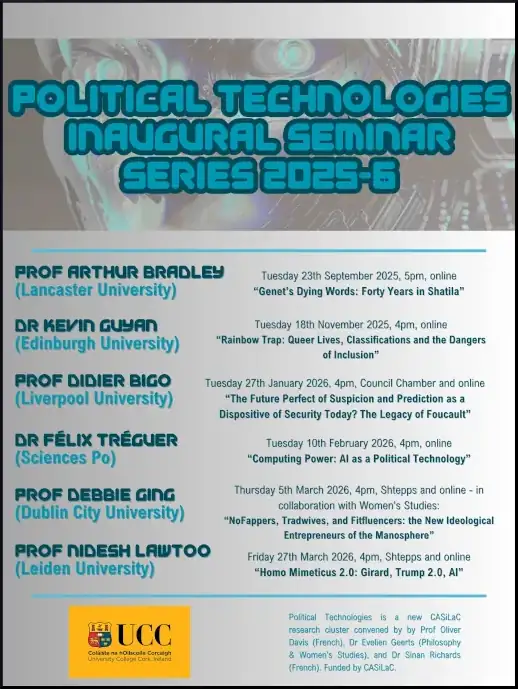
This research cluster aims to study and apply radical theories of politics to generate new understanding of significant social, cultural and technical objects. We draw inspiration from the work of philosopher and historian Michel Foucault, who coined the malleable term ‘political technology’ to describe a variety of social and cultural phenomena ranging from prison design to the practice of confession. Our objective is to foster understanding of critical and activist work on the following types of political technology in particular, within and across different national, cultural and linguistic areas:
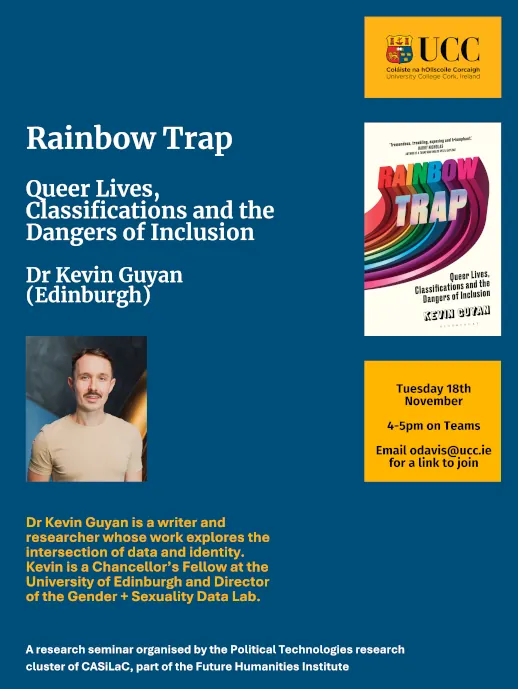
- emancipatory political theory and practice (in particular around ‘race’/ethnicity, gender, sexuality and social class);
- sociogenesis and decolonial practice, in particular psychosocial questions of decolonisation or ‘disenclosure’ (Mbembe);
- ‘somatechnics’ and practices of embodiment;
- techniques of the self and ‘anthropotechnics’ (Sloterdijk), including biomedical technologies;
- bureaucracy, administrative rationality and the passion for order;
- conspiracy theory and misinformation/disinformation;
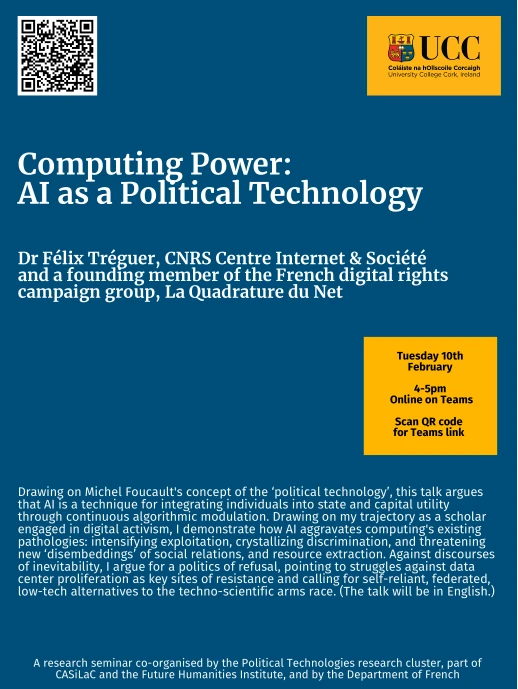
- digital technologies of surveillance and governance.
Our understanding of politics is broad: we believe it extends far beyond political parties, systems and electoral cycles and that many of the most significant political technologies of the Modern and contemporary eras have been developed and taken effect transnationally.
To join the cluster or for more information about our activities please email Oliver Davis at odavis@ucc.ie
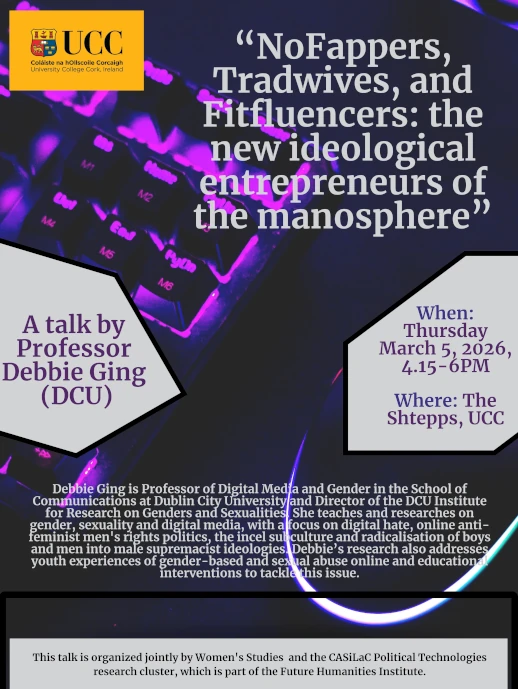
Debbie Ging, Professor of Digital Media and Gender in the School of Communications at Dublin City University and Director of the DCU Institute for Research on Genders and Sexualities, will be joining us in person at UCC on Thursday March 5 in the Shtepps at 4.15PM. All are welcome.
Professor Ging's talk, "NoFappers, Tradwives, and Fitfluencers: the new ideological entrepreneurs of the manosphere", will zoom in on the manosphere; a diverse ecosystem of online anti-feminist and male supremacist groups that has been attracting scholarly attention for well over 10 years, but has only recently entered public debates. More recently, a constellation of economic, technological and socio-cultural factors has significantly transformed the size, reach and communicative politics of this online ecosystem, resulting in four key developments which distinguish it from the earlier manosphere; namely migrations to new platforms, mainstreaming and monetization, ideological and ethnic diversification, and overlap with other extreme ideologies, most of which are driven by recommender algorithms. "NoFappers, Tradwives, and Fitfluencers" addresses the growing diversity and ostensible contradictions of the neo-manosphere, arguing that they can only be fully understood in the context of broader political projects invested in rolling back human rights and facilitating human exploitation at global scale.
This talk is organized jointly by Women's Studies as part of Women's Studies' CACSSS-wide PG7044 module on Gender, Intersectionality & Interdisciplinary Methodologies, International Women's Day, and the Future Humanities Institute (CASiLaC Political Technologies research cluster), which is co-convened by Dr Evelien Geerts (Women's Studies & Philosophy), Professor Oliver Davis (French Department) and Dr Sinan Richards (French Department).
Recent events