
In This Section
Latest news

21 Sep 2026
MIGMOBS Researcher Co-Convenes EuroSEAS 2026 Panel on Migration and Protection in Southeast Asia
Pamungkas Ayudaning Dewanto, a post-doctoral researcher at Waseda University working under the MIGMOBS project, co-convened a panel at the 2026 EuroSEAS Conference held in Madrid from September 1–3, alongside fellow scholars Sverre Molland (Australian National University), Antje Missbach (University of Bielefeld), and Jonathan Krämer (Heidelberg University). The panel, titled "Migration in Southeast Asia: Protection, Infrastructures and Aftereffects," brought together researchers examining how state and private actors shape migration through overlapping, and often contradictory, logics of protection.
Read more
21 Jul 2026
The border in the office
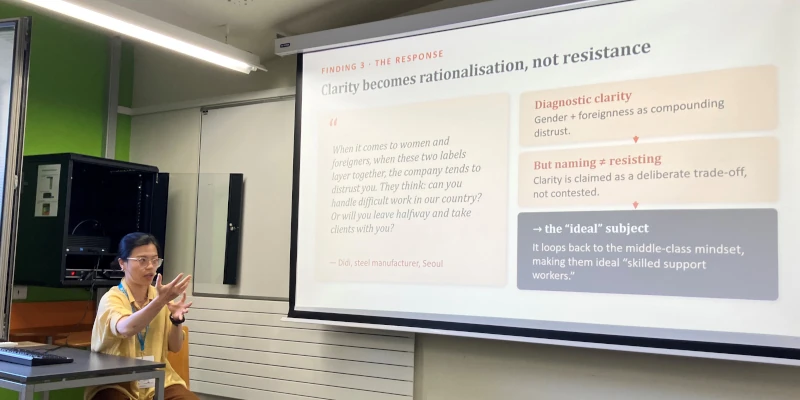
Dr Meiyun Meng, Postdoctoral Research Fellow on the MIGMOBS project at University College Cork, has published “Organisational bordering: Chinese professional women as ‘skilled support workers’ in Japan and South Korea”, co-authored with project PI Adrian Favell. It is the first major publication from the East Asian sub-project, Migration and Mobilities in East Asia: the Chinese in Japan and Korea, and a flagship output of MIGMOBS. The photo above shows Mei presenting the work at the annual IMISCOE conference in Girona, in July 2026.
Read more

13 Jul 2026
MIGMOBS-LATAM : Mapping the changing migration-mobilities systems of South America
De- and re-centering migration studies calls for the development of new empirical studies that take seriously the changing contexts and forms of mobility in different world regions. The MIGMOBS project is well placed to address this task, in terms of its ambitious programme of work on South America, co-led by Ana Paula Penchaszadeh and Adrian Favell.
Read more
07 Apr 2026
Migration in Contentious Times: IMISCOE, Spring 2026
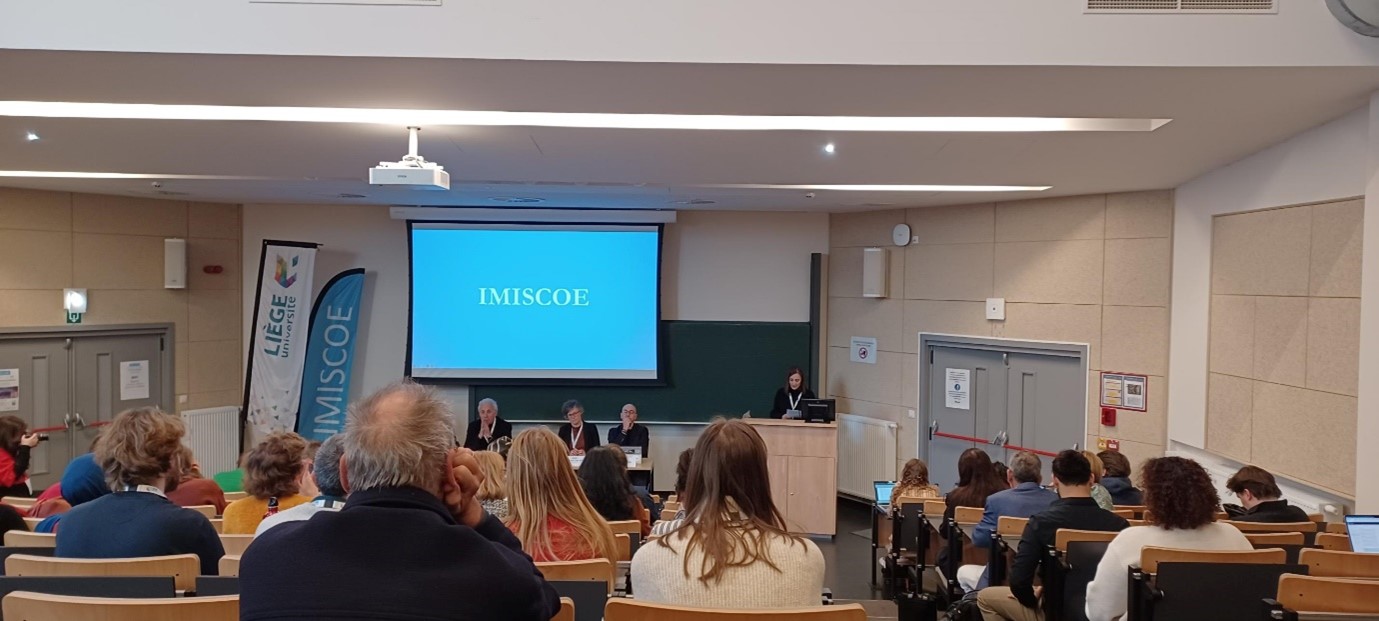
Attending the IMISCOE Spring Conference 2026, which took place from March 16 to 18, 2026, hosted by the Centre for Ethnic and Migration Studies (CEDEM) at the University of Liège, Belgium, offered a timely opportunity to reflect on how migration research itself is evolving in response to increasingly polarised political climates, restrictive migration regimes, and rising anti-immigrant discourses.
Read more
MIGMOBS-related publications
We aim to share MIGMOBS-related publications - browse our publications here.
| Category | Category | Keywords | Year | Title | Abstract | Actions |
|---|---|---|---|---|---|---|
|
Journal Article |
Journal Article | Feminism, Middle-class Chinese women, rock music, Censorship | 2025 |
Rocking Boundaries: Made-in-China Feminism and an All-Female Chinese Band in Tokyo by Meiyun Meng |
This essay examines how Iceless, a Tokyo-based band of highly educated, middle-class Chinese women, redefines gender norms through their music, marking a unique evolution in Made-in-China feminism. Traditional band culture in China often celebrates male success stories in which talent wins fame and love, while women’s bands historically embody ideals of obedience, elegance, and service to male authority. This essay highlights how Chinese women are now resisting these expectations, asserting their agency within the constraints of state and algorithmic censorship. By addressing feminist themes in the diaspora and strategically negotiating boundaries to access the mainland Chinese market, Iceless transforms rock music into a platform for subtle yet impactful grassroots feminist expression. Their journey illuminates how Made-in-China feminism actively shapes gender politics, revealing women’s rock bands as a transformative force in the broader evolution of gender politics in China. | More details Read publication |
|
Journal Article |
Journal Article | 2025 |
Tackling ‘scandalous inequalities’: A Global Policy Proposal for a Humanity Identity Card and Basic Income Supplement by Ettore Recchi and Tobias Grohmann |
Food insecurity and the absence of legal identity are the most severe deficiencies in vital and existential human capabilities. These extreme situations expose ‘scandalous inequalities’ between the haves and have-nots on a global scale. The article proposes addressing these issues simultaneously by introducing a Humanity Identity Card (HIC), coupled with a Basic Income Supplement (BIS) of US$ 1 per day for the most vulnerable half of the world’s population. This global social policy aims to expedite the achievement of Sustainable Development Goals 16.9 and 2.1 of the United Nations. The initial funding for the HIC could be sourced from contributions amounting to 0.66% of the gross domestic product of sovereign states, 0.66% of the market capitalisation of major corporations, and 0.66% of the wealth of billionaire households. The HIC would permanently provide universal recognition of individual identity, while the BIS is designed to be gradually phased out as its benefits take effect. Additionally, implementing this policy worldwide can foster a sense of shared responsibility in addressing the global challenges humanity faces. | More details Read publication | |
|
Journal Article |
Journal Article | 2025 |
Space-Sets: Introducing and Testing a Multi-Dimensional Measure of Individual Transnational Mobility by Ettore Recchi |
Existing research on the transnational mobility of individuals tends to rely on limited and possibly misleading indicators. Arguing that mobility experiences are in fact multidimensional and cumulative over the course of a lifetime, this paper proposes a novel concept called ‘space-set’ and applies it to representative samples of the population in France, Germany and Italy (ELIPSS, GP.pop and Doxa surveys). A space-set is defined as the collection of each person’s geographical places known through first-hand experience. In a transnational perspective, its key dimensions are Size (the number of countries visited), Width (the farthest distance traveled), and Focus (being emotionally attached or not to more than one country). This new indicator measures individual-level inequalities of geographical mobility. As a proof of concept, the empirical part of the paper uses space-sets to address two research questions that loom large in different strands of the literature on social transnationalism: on the one hand, the social stratification of cross-border travel, on the other the association between transnational mobility and supranational orientations (i.e., cosmopolitan and pro-EU attitudes). Results confirm that space-sets are socially stratified by both class and education, and that larger, wider, and more transnationally oriented space-sets are associated with supranational orientations. Comparatively, all dimensions of space-sets are stronger in the German population than in their French and Italian counterparts. | More details Read publication | |
|
Journal Article |
Journal Article | 2026 |
Contemporary genealogy of forced displacement in Africa in the light of border conflicts by Kheira Arrouche |
The causal link between border conflicts in Africa and forced displacements is not always clear in terms of cause and effect. We intend to highlight this contemporary reality through our contribution. Our argument is developed in three stages. First, we will focus on the trends of pacification and conflictualisation of borders at the global and African level; Second, we will return to the historical conditions of formation of African borders and subsequent developments which are certainly determining due to colonial divisions and societal fractures; however, they remain insufficient to explain the perpetuation of forced migrations after independence. Third, we will attempt to estimate the impact of border conflicts in Africa on forced displacements. To do this, we will mobilize a methodology based on documentary and statistical research. The results relativize the dramatization of migrations specific to the continent and the permanent guilt of colonization, confirm that African borders are in a process of appropriation and evolution in conflicts. While establishing the link between forced migrations and border conflicts, other indigenous and exogenous factors would exist. | More details Read publication | |
|
Conference Paper / Proceedings |
Conference Paper / Proceedings | Migration brokerage, Indonesia, sending region | 2024 |
Exploring the impact of sending companies on Indonesian labor migration trajectories by Gracia Liu-Farrer |
Labor migration from Indonesia relies heavily on intermediaries, particularly migrant sending companies, which constitute a crucial part of the migration infrastructure. While recent research has increasingly focused on the facilitative role of intermediaries in channeling individual migrants' cross-border labor mobility, this study examines these intermediaries as distinct actors who have unique identities, exhibiting diverse resources and practices that significantly influence migrants' migratory trajectories. Based on extensive fieldwork data collected in Indonesia and dozens of interviews with representatives of a diverse sample of sending companies and migrant work seekers across different regions, this presentation sheds light on how sending companies' identities are shaped by their historical backgrounds, cultural values, and organizational history. These distinct identities are manifested in their transnational networks, their relationship with the governing bodies, the types of employment opportunities they offer, and their operational approaches in the migration business. We demonstrate how such varying identities of sending companies play a pivotal role in shaping migrant workers' migration trajectories, particularly in determining the choice of destination country, occupation, and the conditions under which they migrate. The existence of different sending companies creates specific channels that influence divergent migration paths to various countries pursued by migrant workers and their potential wellbeing. | More details Read publication |
|
Journal Article |
Journal Article | migration brokerage, migration industry, labor migration, Indonesia | 2025 |
Building the channels, keeping the gates: The role of intermediaries in shaping differentiated transnational labor mobilities out of Indonesia by Gracia Liu-Farrer |
IDrawing on government statistics and in-depth interviews with owners and directors of 21 migrant worker sending companies in Indonesia, we identify three types of migrant worker sending companies that engage in and facilitate Indonesia’s overseas labor placement—the providers, the pioneers, and the protectors. We argue that in a changed labor-sending context, only those sending companies with strong and positively received identities and practices can sustain their businesses and succeed in recruiting workers, indicating a shift in relationships between labor intermediaries and migrant workers, as well as the role of intermediaries in shaping Indonesia’s labor-sending patterns. | More details Read publication |
|
Conference Paper / Proceedings |
Conference Paper / Proceedings | women brokers, migration industry | 2025 |
Brokering care: Women migration entrepreneurs in Indonesia by Gracia Liu-Farrer |
Every year, hundreds of thousands of Indonesians migrate for work abroad, and over ninety-five percent of these workers are recruited through private agencies. Among the top 25 agencies, twelve are led by women. These female migration entrepreneurs vary in background and strategy: some specialize in dispatching domestic workers to single destinations, while others eschew care work to pursue placement in formal sectors such as manufacturing and services. Regardless of placement focus, their success—measured in deployment volume—is largely built on reputations for low-cost or zero-cost recruitment and placement efficiency. Yet these women are not merely businesspeople; they are entangled in the shifting politics of migration governance and industry competition. Drawing on interviews and ethnographic observations, this paper explores how these women navigate the moral and political terrain of labor brokerage. It highlights how they strive to uphold what they see as ethical recruitment practices, reimagine their work as a form of social service, and pursue a vision of gendered progress and worker dignity. | More details |
|
Journal Article |
Journal Article | Venezuela | 2025 |
Pour une hospitalité élargie selon une perspective amérindienne by Ana Paula Penchaszadeh |
Vers les années 1980, au Venezuela, j’ai écouté un récit relatif à un peuple originaire qui est resté gravé dans ma mémoire comme quelque chose qui devait être soigneusement analysé et travaillé à un moment donné, car il apportait un éclairage sur mes sentiments de l’époque, en tant que migrante et, par la suite, à ma pensée en tant que migrantologue : lorsque des personnes appartenant à un certain peuple entreprennent des voyages, une fois arrivés à leur destination, ils restent immobiles et silencieux pendant plusieurs heures, attendant que leur âme arrive et rejoigne leur corps. Ce peuple comprend que le corps se déplace plus vite que l’âme et que les mouvements liés au voyage et à la migration produisent un décalage entre l’ordre objectif du soma (corps) et l’ordre subjectif de la psyché (âme). Dans ce texte nous cherchons à comprendre cette scène à partir d’une perspective différente de l’hospitalité, en tant que moment spécifique et intensif d’un être par définition pluriel se tissant dans la Relation, le mouvement, et le devenir. Pour faire jouer différemment la relation espace-temps impliquée dans la migration, le voyage, l’arrivée et l’accueil, on abordera dans un premier temps de manière critique la tradition indo-européenne, en montrant comment la problématique générale de l’hospitalité a été enfermée dans les limites du don sacrificiel et de l’économie violente de l’identité/différence ; dans un deuxième temps, nous nous tournerons vers une autre façon de penser l’accueil, qui suppose l’altération et l’implication mutuelles de l’être-avec-autrui du nous-autrui, à partir des scènes amérindiennes qui fondent notre façon particulière de consteller le social… | More details Read publication |
|
Journal Article |
Journal Article | 2025 |
Normalizing exceptions and accepting differences: Japan’s pragmatic pathway to becoming an immigrant country by Gracia Liu Farrer |
One of the most captive and resilient notions reified in post-war Japanese society is that Japan is a racially homogeneous island nation. This ethnonationalist ideology has contributed to the Japanese government’s resistance to immigration for decades. However, confronted with increasing demographic crises and skills shortages, Japan has been opening its door wider toward foreigners, making it a de facto immigrant society. This paper highlights two parallel processes in this development: the normalization of exceptions and the acceptance of differences. The first process is at the national government level, happening in the policy arena, and the second is more localized, involving a wide range of people, organizations, and local governments. Nonetheless, for Japan to transform into an immigrant society, two ideological barriers need to be overcome: One is the discourse of “no-immigration”, and the other is the identity-binary of “Japanese” versus “foreigner”. These two discourses exert influences on both policymaking and everyday life. The paper argues that where Japan is heading is very much contingent upon whether, when, and under what conditions such discourses will be abandoned. | More details Read publication | |
|
Journal Article |
Journal Article | 2025 |
Neoliberal humanitarianism: Contradictory policy logics and Syrian refugee experiences in Japan by Gracia Liu-Farrer |
Since the 2011 beginning of the Syrian uprising, more than 800 Syrians have become registered residents of Japan. Japan is an unusual destination for these refugees due not only to its geographical and cultural distance from the Middle East and lack of Arab diasporic communities, but also to what we call neoliberal humanitarianism: an approach by which states adopt policies and programmes to reduce refugees’ suffering while also regarding refugees as potentially profitable workers responsible for their own economic survival and social integration. In Japan’s case, the driver of neoliberal humanitarianism is its interest in keeping par with G7 peers in ‘doing something’ in the face of a global ‘refugee crisis’ on the one hand, and its lack of political or social will to receive refugees, on the other. The contradictions inherent in these imperatives come to the fore in the ‘Japanese Initiative for the future of Syrian Refugees’ (JISR), which invites Syrian refugees to pursue graduate degrees at Japanese universities. Japan officially presents JISR participants as refugees, but legally regards them as students, provides limited financial support, and encourages them not to apply for asylum. This article investigates JISR as a case study of neoliberal humanitarianism and examines its contradictory logics and consequences, from the perspective of refugees’ experiences. Qualitative analysis of twenty-one original interviews shows that, though Syrians often choose Japan in search of stability after years of precarity in countries on Syria’s borders, neoliberal humanitarianism in this unusual destination generates a new chapter of uncertainty and disappointment. | More details Read publication | |
|
Journal Article |
Journal Article | 2025 |
Japan’s Stalled Immigration Experiment: The Uncertain Future of a Promising Approach by Gracia Liu-Farrer |
More details Read publication | ||
|
Journal Article |
Journal Article | 2025 |
Argentina y los venezolanos: Un ejemplo en la materia de regularización migratoria by Ana Paula Penchaszadeh |
More details Read publication | ||
|
Journal Article |
Journal Article | 2025 |
Balance de la política migratoria del gobierno de Alberto Fernández (2019-2023): El acceso a la documentación argentina bajo la lupa by Ana Paula Penchaszadeh |
The purpose of this article is to analyze Argentina’s migrant regularization policy implemented under the administration of Alberto Fernández, between 2019 and 2023. The proposed theoretical-ethodological approach is based on the analytical distinction of three levels: 1) legal-normative, 2) bureaucratic-administrative and 3) sociodemographic (the effects or impact of the regularization policy on the migrant population). Through a cross-referencing of primary and secondary sources, the analysis also differentiates the policies according to whether they were oriented to manage the urgency, generate compensation mechanisms or normalize and standardize the public agency. Finally, the manuscript includes a specific section that systematizes and addresses key statistical information to longitudinally measure the impact of migration regularization policies in the period under study. In the conclusions, the findings are taken up and the regularization conditions bequeathed to the next government are indicated. | More details Read publication | |
|
Journal Article |
Journal Article | 2026 |
Afterlives of decolonisation: the racialisation of West and Central African migrants in contemporary Algeria by Kheira Arrouche |
This article investigates the racialisation of West and Central African migrants in Algeria; a state historically celebrated for its anti-colonial solidarity. Through ethnographic fieldwork in Oran and Algiers, it centers the migrants’ lived experiences to reveal a pervasive landscape of everyday racism and dehumanisation. The analysis argues that Algerian racial formations exceed Euro-American binaries, operating through context-specific logics that render Blackness hyper-visible yet structurally excluded. The article traces contemporary anti-Blackness to what I term the afterlives of decolonisation, through which the legacies of slavery, French colonisation, and religious hierarchies continue to shape racial formations in postcolonial Algeria, marginalising and erasing Black histories and presence within dominant Arab-Islamic national imaginaries. Ultimately, the study reveals how a state forged through liberation struggle reproduces colonial structures of negation, casting Blackness as a threatening “other” incompatible with Algerian identity. | More details Read publication | |
|
Journal Article |
Journal Article | 2026 |
Counter-trafficking Policies and the Overseas Labour Protection Regime in Indonesia: Between Populism and Securitisation by Pamungkas A. Dewanto |
After the 1990s, in addition to the European cases, scholars working on human trafficking also put major attention to Southeast Asia. This article contributes to the discourse on the nexus between labour migration and human trafficking by analysing the politics surrounding counter-trafficking policymaking in Southeast Asia, particularly Indonesia. This study investigates two interrelated domestic factors influencing the evolution of the state's counter-trafficking framework: (1) the integration of labour protection within a populist policy agenda and (2) the securitisation of labour migration. Combined with the global discourse on labour trafficking, such intertwining factors have resulted in the counter-trafficking approach which tends to criminalise actors within the labour migration sector. Drawing upon extensive fieldwork conducted between 2022 and 2024 in multiple sites in Indonesia, this research argues that domestic political dynamics, when considered alongside broader global debates on human trafficking, have significantly shaped the government's direction in counter-trafficking policy development. | More details Read publication | |
|
Journal Article |
Journal Article | 2025 |
La Encuesta de Trayectorias Adolescentes en el AMBA (2023): reflexiones metodológicas y resultados preliminares by Natalia Debandi and Joanna Sander |
Este artículo presenta los aspectos metodológicos del desarrollo y la aplicación de la Encuesta de Trayectorias a adolescentes y jóvenes (ETrA) subrayando los desafíos y aprendizajes en la producción de datos primarios desde la academia, con un enfoque práctico de derechos humanos. La encuesta, desarrollada en el marco de un proyecto en curso que lleva adelante el Observatorio de Adolescentes y Jóvenes (IIGG UBA), tuvo como objetivo evaluar los efectos de las políticas públicas y las percepciones de les adolescentes sobre discriminación, exclusión y violencia estatal. Realizada entre abril y octubre de 2023 en seis partidos del AMBA, la ETrA recopiló alrededor de 300 respuestas de adolescentes de sectores populares. Entre las conclusiones del artículo, se destaca la importancia del small data a la hora de captar las especificidades de las trayectorias biográficas de colectivos como el de adolescentes, fundamentalmente en relación a las temáticas abordadas por la ETrA. | More details Read publication | |
|
Journal Article |
Journal Article | International student mobility, migration, infrastructure, talent, governance, subnational, Indonesia | 2026 |
Subnational migration infrastructure and international student mobility: insights from Indonesia’s "Beasiswa NTB" programme by Pamungkas A. Dewanto |
Drawing on the case of Beasiswa NTB—a subnational scholarship programme funded by the provincial government of West Nusa Tenggara, Indonesia—this article examines how institutional actors, regulatory mechanisms, and logistical arrangements mediate trajectories of international student mobility (ISM). In a setting where opportunities for overseas study are uneven and limited, the provincial government emerges as a pivotal actor, not only in facilitating student departures but also in defining eligibility criteria and shaping the directionality of mobility pathways. The article shows that Beasiswa NTB operates through a complex interplay between formal governance structures and ad hoc bureaucratic practices, which often reproduces rather than alleviates inequality. It argues that this dynamic is driven by a regulatory framework designed to expedite student mobility without adequate institutional consolidation, resulting in bureaucratic circumvention, the proliferation of informal arrangements with limited oversight and accountability, standard-lowering practices, and heightened vulnerability to political intervention. | More details Read publication |
|
Journal Article |
Journal Article | 2025 |
Voto inmigrante en la provincia de Buenos Aires: la política subnacional de empadronamiento bajo la lupa by Ana Paula Penchaszadeh |
More details | ||
|
Journal Article |
Journal Article | 2024 |
“¡Todo salía de mi vagina!”: Migración venezolana y trabajo sexual en clave singular by Ana Paula Penchaszadeh |
El objetivo de este artículo es analizar el caso particular de una trabajadora sexual migrante venezolana. Para ello, en primer lugar, se aborda el fenómeno de la feminización de las migraciones y, al interior de este fenómeno, el funcionamiento del mercado sexual transnacional. En segundo lugar, siguiendo el hilo de una entrevista semiestructurada en profundidad y varias interacciones posteriores, bajo la estructura del diálogo, se abordan algunas de las principales características de la migración venezolana, así como las lógicas del mercado sexual y el funcionamiento de las redes de trata y sujeción con base en la deuda y el cuidado. La investigación se sustenta metodológicamente en la perspectiva de la sociología de las migraciones, al considerar la unidad biográfica del migrante en un campo social transnacional en los que se articulan estructuras, agencias, poderes y resistencias. | More details Read publication | |
|
Book chapter |
Book chapter | 2024 |
Migraciones y acceso a la seguridad social en la Argentina hoy: La imposible universalidad by Ana Paula Penchaszadeh and Julieta Nicolao |
More details |
MIGMOBS ERC AdG Project 101097240
Contact us
Radical Humanities Laboratory, Wandesford Quay Research Facility, University College Cork, Republic of Ireland
- migmobs@ucc.ie
- Professor Adrian Favell, Project PI