
In This Section
- Home
- About
- News
- Research Projects
- Great Saltee Island Seabird Conservation
- Estimating and mitigating the impact of bird damage to crops in Ireland
- The ecology of the Red Grouse in Ireland
- The conservation ecology of a declining population of hen harriers
- The spatial and population ecology of White-tailed Eagles since their reintroduction to Ireland
- Sustainability measures in cereal production
- Using spatial ecology to develop a sustainable habitat management strategy for red-billed chough in Ireland
- The distribution and behaviour of the European Storm-petrel at sea
- People
- Gallery
- How to Find Us
Project Overview
Because seabirds spend the majority of their life at sea and feed near the top of the food chain, changes in their populations are likely to reflect changes occurring in the wider ecosystem, making them excellent indicators of the health of the marine environment. Impacts from fisheries, pollution, invasive predators, habitat destruction and human disturbance can occur at any stage of the seabird annual cycle, making year-round monitoring important. Intensive monitoring at many locations becomes prohibitively expensive given the number of seabird species and breeding sites globally, and long-term monitoring programs needed to assess population trends are often hampered by difficult to access colonies. Camera technology affords us the ability to collect data in hard-to-reach areas, or in places where human presence might disturb wildlife, and better understand how changes in the marine environment affect seabirds.
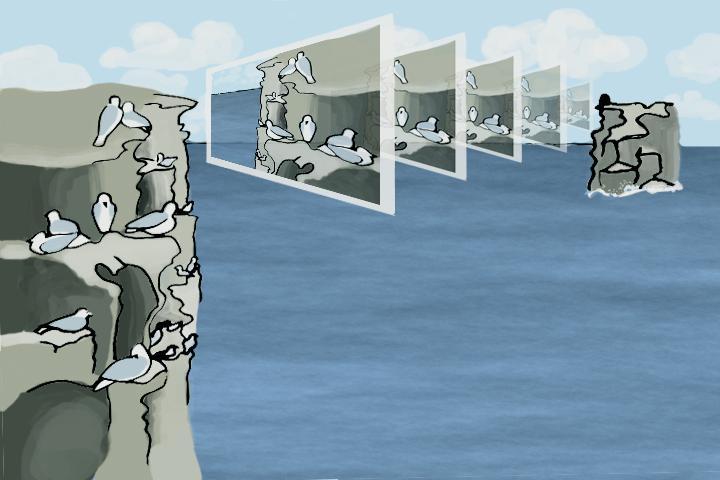
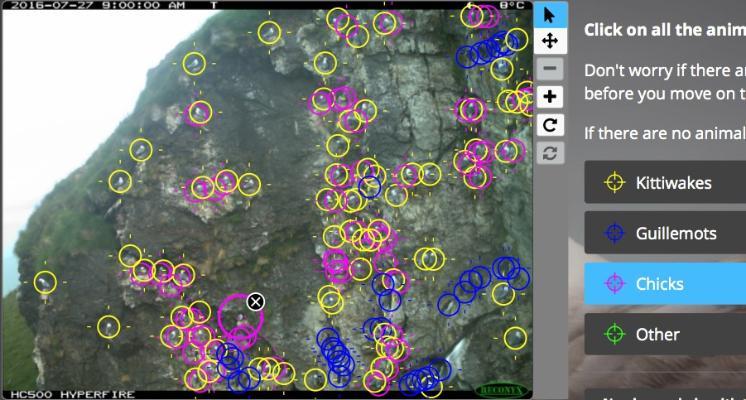
This approach generates an enormous amount of data in the form of hundreds of thousands of images. In order to turn this massive database of information into a data set that we can use to answer research questions, volunteers can log onto the seabirdwatch platform, and help us identify birds in images.
Images taken throughout the year at multiple locations provide the ability to answer a range of interesting questions. Specifically, we aim to:
- Determine chick survival and breeding success, and how this varies across species ranges.
- Identify the causes of chick mortality (e.g. predation in the colony versus parents abandoning chicks)
- Record changes in the timing of breeding (e.g. arrival date, fledging date) and how this is affected by environmental conditions
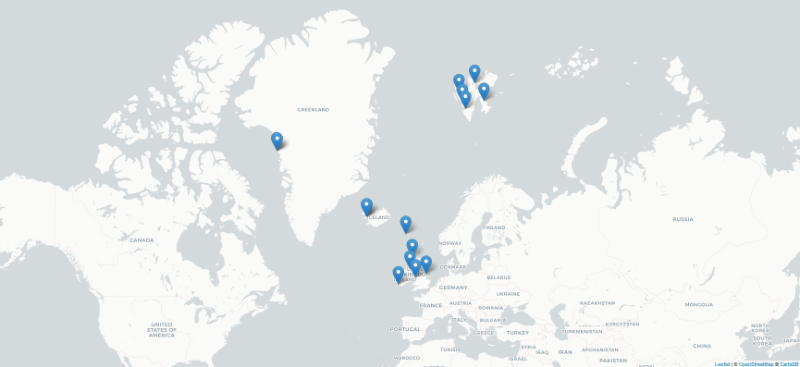
We have many camera monitoring sites around the North Atlantic. The images in this project come from Ireland, Northern Ireland, Wales, Iceland, Svalbard, Faroes and Greenland so far.
Volunteers can participate by going to www.seabirdwatch.org and following the tutorial.
People
- Dr Mark Jessopp
- Dr Tom Hart
Supported by
UCC Ornithology Research Group
Contact us
School of Biological, Earth and Environmental Sciences, UCC North Mall Campus, North Mall, Cork City,