Political Technologies

This research cluster aims to study and apply radical theories of politics to generate new understanding of significant social, cultural and technical objects. We draw inspiration from the work of philosopher and historian Michel Foucault, who coined the malleable term ‘political technology’ to describe a variety of social and cultural phenomena ranging from prison design to the practice of confession. Our objective is to foster understanding of critical and activist work on the following types of political technology in particular, within and across different national, cultural and linguistic areas:
- emancipatory political theory and practice (in particular around ‘race’/ethnicity, gender, sexuality and social class);
- sociogenesis and decolonial practice, in particular psychosocial questions of decolonisation or ‘disenclosure’ (Mbembe);
- ‘somatechnics’ and practices of embodiment;
- techniques of the self and ‘anthropotechnics’ (Sloterdijk), including biomedical technologies;
- bureaucracy, administrative rationality and the passion for order;
- conspiracy theory and misinformation/disinformation;
- digital technologies of surveillance and governance.
Our understanding of politics is broad: we believe it extends far beyond political parties, systems and electoral cycles and that many of the most significant political technologies of the Modern and contemporary eras have been developed and taken effect transnationally.
To join the cluster or for more information about our activities please email Oliver Davis at odavis@ucc.ie

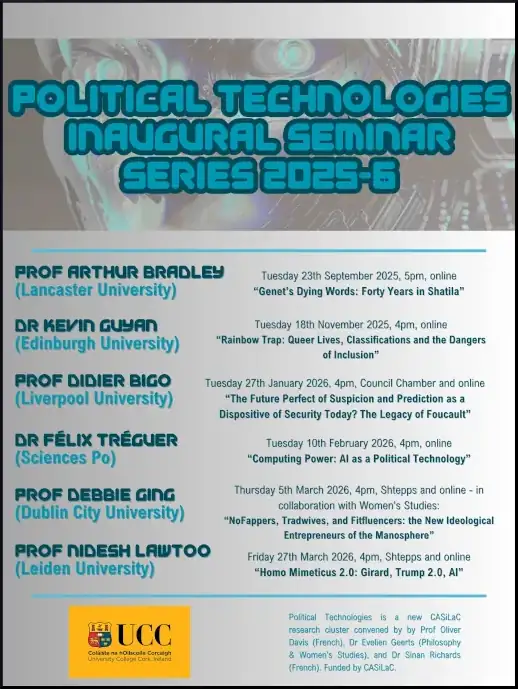
For the final event in our inaugural research seminar programme, the Political Technologies cluster is delighted to welcome Professor Nidesh Lawtoo (Leiden) to UCC. Professor Lawtoo will speak at 4pm on Friday 27th March, in The Shtepps and online. This is the Teams link to join online.
What role did imitation play in the election of Trump 2.0? And if René Girard's mimetic theory could be used to critique (new) fascism in the past, can it also be abused to program AI technologies of oppression in the present and future? This talk aims to address such questions from the interdisciplinary perspective of mimetic studies attentive to the patho(-)logies of Homo Mimeticus 2.0.
Professor Nidesh Lawtoo is a philosopher and cultural/literary critic and Professor of Modern and Contemporary European Literature and Culture at Leiden University. He led the ERC project Homo Mimeticus, and he is the author of several books that open up the field of mimetic studies, including (New) Fascism, a diptych on Violence and the Unconscious, and an ongoing mini-series on Homo Mimeticus.
Recent events