
In This Section
- Home
- Semester and Timetable Information
- Study Physics
- Our Research
- Our People
- Careers and Alumni
- Seminars, News and Events
- Outreach and School Resources
- About the School
- What is Physics
- The Crawford Observatory
- Frequently Asked Questions
- UCC Futures Quantum & Photonics
- Supports/EDI
Kicking Wire Apparatus
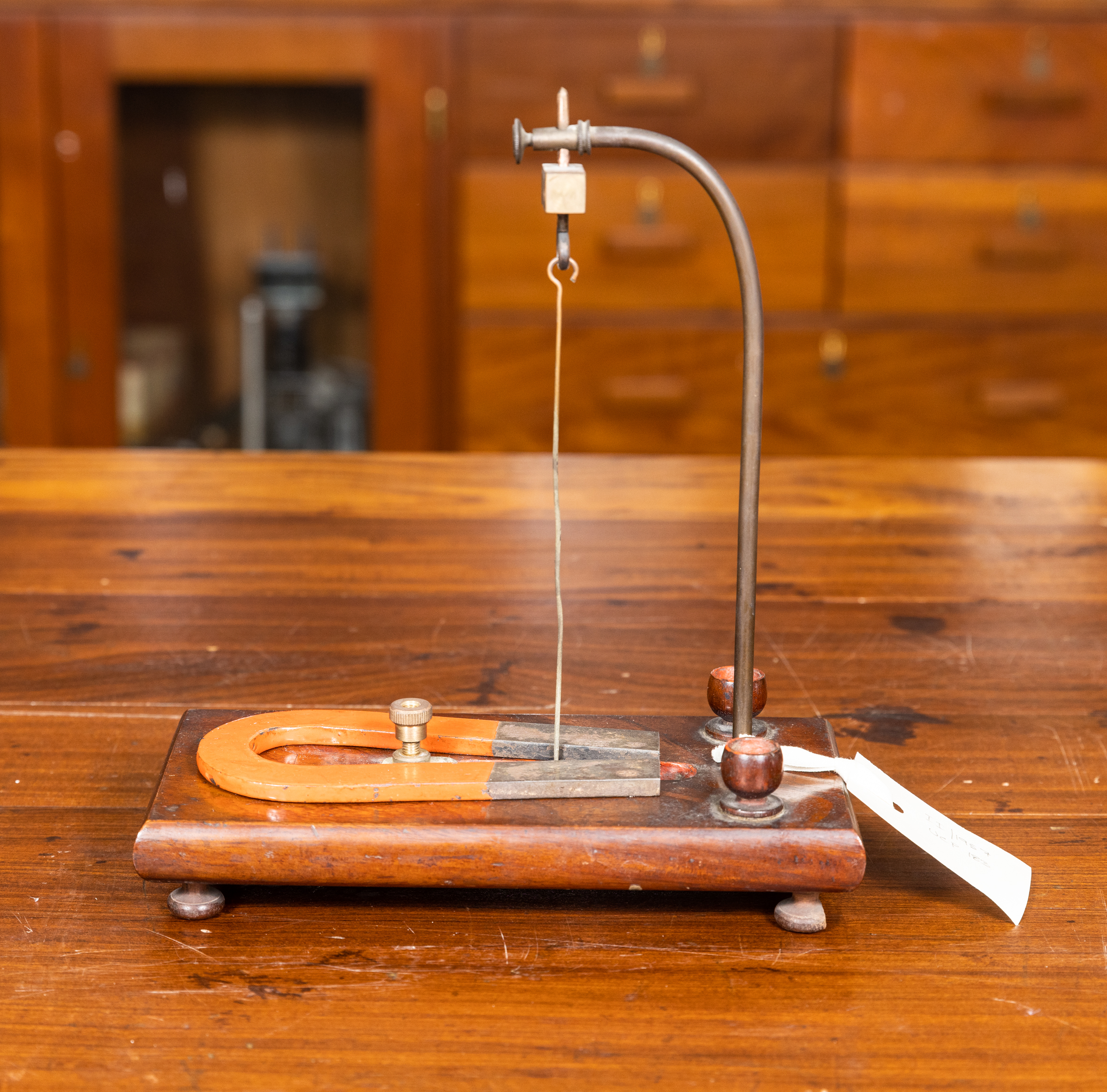
This apparatus was fabricated in the mid-19th century and illustrates an early experimental demonstration of the interaction between electricity and magnetism.
The kicking wire apparatus demonstrates that a mechanical force acts on a current-carrying conductor placed in a magnetic field.
A fine wire is freely suspended in air, with its lower end able to move between the poles of a horseshoe magnet. The wire dips into a mercury-filled trough, which completes the electrical circuit. When an electrical current is applied through the mercury, the wire experiences a force and “kicks” toward the magnet’s south pole.
As the wire moves, it breaks contact with the mercury, interrupting the current. Without current, the force disappears and the wire falls back into the mercury, restoring electrical contact. This cycle then repeats continuously, producing the characteristic kicking motion.
Key observations:
-
Without the magnet, the wire does not move.
-
Reversing the direction of the current causes the wire to kick toward the north pole instead.
The example shown is recorded in the National Inventory of Historic Scientific Instruments by Charles Mollan (entry 4957 UCP 183). The device consists of a mahogany base, a brass crook rising over the mercury trough, a suspended wire, and a horseshoe magnet positioned around the trough.
School of Physics
Scoil na Fisice
Contact us
Room 213 (Physics Office), 2nd floor, Kane Science Building, University College Cork, Ireland.,